Signs of a Quality Peptide Compounding Pharmacy
Worried about quality? Learn the critical questions to ask any peptide compounding pharmacy, plus the red flags that signal you should stay away.
This content is for informational purposes only and does not constitute medical advice. Always consult with a qualified healthcare provider before starting any new treatment.
The world of peptide therapy is rapidly expanding in 2026, with exciting new research and greater patient access. However, this growth has created a confusing market where quality and safety can vary dramatically. Finding a legitimate peptide compounding pharmacy is the single most important step to ensure your therapy is both effective and safe. With recent FDA rule changes, knowing how to source your peptides correctly is more critical than ever.
This guide will walk you through the current regulatory environment, provide a checklist for vetting a quality peptide pharmacy, and highlight the serious risks of unregulated online suppliers.
The 2026 FDA Reclassification: A New Chapter for Peptides
For years, the legal status of many popular peptides was uncertain. In 2023, the FDA placed several compounds, including BPC-157 and CJC-1295/Ipamorelin, on a restricted list (Category 2), limiting their availability from compounding pharmacies. This pushed many patients toward a risky, unregulated online space sometimes called the "peptide forum grey market."
Everything changed in early 2026. In February, HHS Secretary Robert F. Kennedy Jr. announced a landmark decision to move approximately 14 of these peptides from the restrictive Category 2 list back to Category 1 (the "Bulk Drug Substances List"), following significant legal challenges and lobbying from the medical and pharmacy communities (PeptideVerdict, Feb 2026).
This policy shift, while still awaiting its final effective date as of April 2026, is a huge win for patient access. According to a March 2026 status update, this change is expected to restore clear, legal compounding access for peptides like:
- BPC-157
- CJC-1295/Ipamorelin
- Thymosin Alpha-1
- AOD-9604
This means that with a valid prescription, licensed compounding pharmacies can once again prepare these therapies for individual patients. One notable exception is TB-500, which is likely to remain restricted due to specific FDA concerns about cell proliferation (Peptidemark, March 2026).
At the same time, access to compounded GLP-1 medications like semaglutide and tirzepatide has become more limited. Compounding was permitted during FDA-declared drug shortages, but as the supply of branded drugs like Ozempic and Mounjaro has recovered, the FDA is increasing enforcement against non-compliant compounders (CalcMyPeptide, 2026).
Navigating these regulatory changes can be confusing. Not sure which peptides are available or right for your health goals? Take our free quiz to get matched with a knowledgeable provider who stays up-to-date on the latest regulations.
How to Vet a Legitimate Peptide Compounding Pharmacy
With greater access comes greater responsibility for patients. The 2026 FDA reclassification emphasizes that while these peptides can be compounded, they are not FDA-approved drugs with standardized manufacturing oversight. Quality is the most important variable (Peptidemark, 2026). A low-quality or contaminated peptide is not only ineffective but also dangerous.
Use this checklist to verify any peptide compounding pharmacy before filling a prescription.
1. Licensing and Pharmacy Type (503A vs. 503B)
First, ensure the pharmacy is licensed in the United States. There are two main types of compounding pharmacies that can legally prepare peptides:
- 503A Pharmacies: These are traditional compounding pharmacies that prepare medications for individual patients based on a specific prescription. This is the most common type of pharmacy you will encounter for peptide therapy.
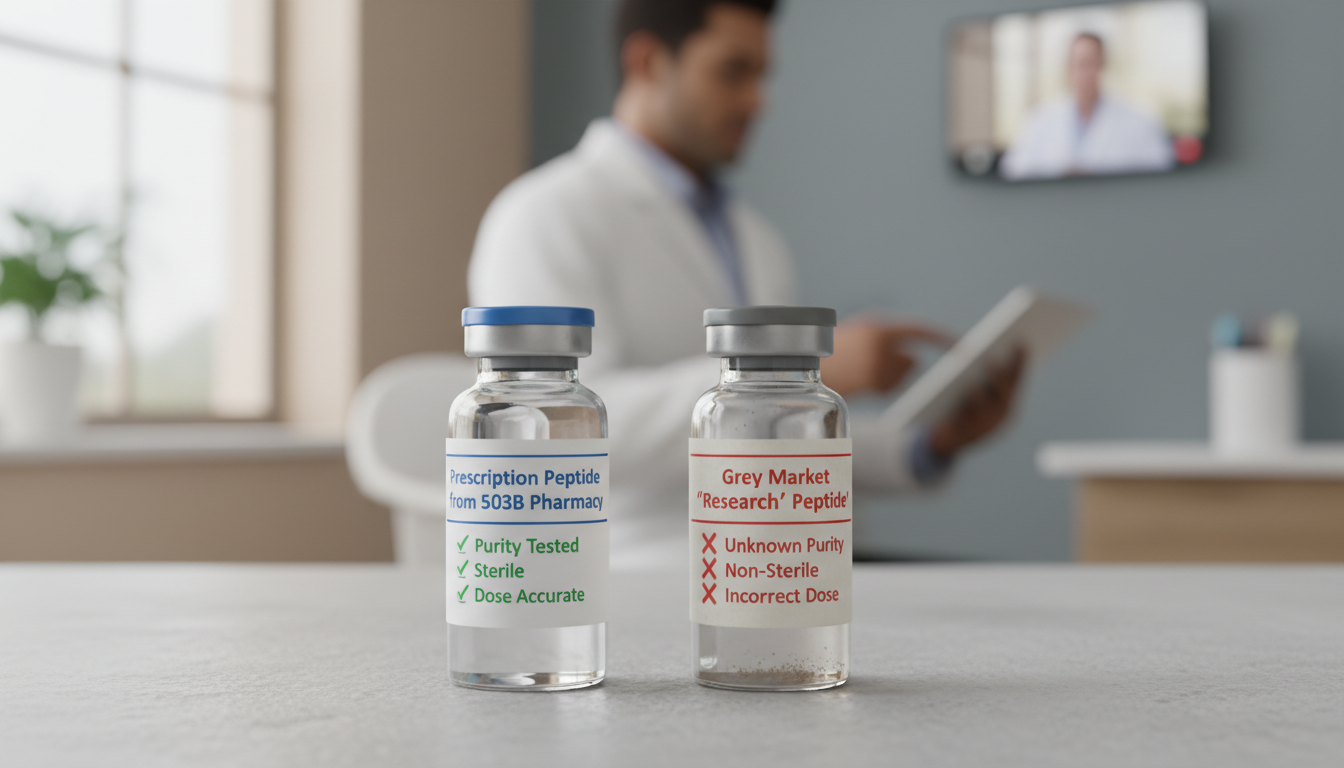
- 503B Outsourcing Facilities: These facilities are registered directly with the FDA and can produce large batches of compounded drugs under much stricter Current Good Manufacturing Practices (cGMP). They are held to a higher quality standard, similar to commercial drug manufacturers. Sourcing from a 503B facility is often an indicator of higher quality (
CalcMyPeptide, 2026).
2. A Valid Prescription is Mandatory
A legitimate peptide pharmacy will always require a valid prescription from a licensed healthcare provider, like a medical doctor (MD), doctor of osteopathy (DO), or nurse practitioner (NP). If a website offers to sell you injectable peptides with no prescription needed, it is not a licensed pharmacy and you should avoid it.
3. Demand a Certificate of Analysis (COA)
This is the most critical step. A Certificate of Analysis is a lab report that details the quality and purity of a specific batch of a drug. Do not proceed without one. When you receive your peptide, it should come with a COA, or the pharmacy should be able to provide it upon request.
Here’s what to look for on the COA:
- Purity: This shows the percentage of the active peptide in the sample. For most peptides, you should look for a purity of over 98% (
Peptidemark, 2026). - Sterility: This test checks for microbial contamination. The result must say "Pass" or "Sterile."
- Endotoxin Levels: Endotoxins are harmful substances from bacteria that can cause a severe immune response. The COA should show that endotoxin levels are well below the safe limit set by the United States Pharmacopeia (USP).
4. Look for Third-Party Accreditation
While not mandatory, accreditation from the Pharmacy Compounding Accreditation Board (PCAB) is a strong sign that a pharmacy is committed to high quality standards. A pharmacy with PCAB accreditation has voluntarily undergone a rigorous inspection process covering its procedures, staff, and facility.

The Dangers of the Grey Market and Unverified Suppliers
The cost savings of unregulated online sellers can be tempting, but the risks are immense. Discussion forums and social media often point users to websites selling peptides labeled "For Research Use Only" (RUO). These products are not made for human administration. They are not produced in sterile environments and have no quality control for safety or purity. The "peptide supplier usa" that people find this way is often just a reseller of raw materials not intended for patients.
A Stark Warning: The Compounded Tirzepatide Crisis
The situation with compounded tirzepatide provides a chilling example of what can go wrong. As demand for the weight-loss drug skyrocketed, a black market of unregulated compounders emerged. The consequences have been severe.
In early 2026, Eli Lilly, the manufacturer of Mounjaro and Zepbound, issued a warning about fraudulent compounded tirzepatide. Testing revealed some products contained nothing more than sugar alcohol, while others were filled with high levels of unknown impurities (Peptidemark, 2026).
Worse still, a March 2026 scientific report identified a novel, widespread impurity in mass-compounded tirzepatide mixed with vitamin B12. This impurity, a chemical adduct formed between the two molecules, was found at levels up to 10% of the total peptide content. Researchers also found that the actual potency of these products varied wildly, with some containing as little as 43% of the advertised dose (medRxiv, 2026).
These quality failures have real-world consequences. As of December 2025, the FDA had received 455 adverse event reports linked to compounded tirzepatide, including 8 deaths (medRxiv, 2026).
The lesson is painfully clear. Whether you're searching online for peptide injections austin or looking for peptide therapy calgary, the principles of safe sourcing are universal. Bypassing a doctor and a licensed peptide compounding pharmacy to save money is a gamble with your health. International interest is also growing, with many seeking information on peptide therapy hong kong or the best peptide clinic in dubai, but the same rules of safety and verification apply everywhere.
The risks of the grey market are real. Don't leave your health to chance. Our free 3-minute quiz connects you with vetted clinics that work exclusively with high-quality, licensed pharmacies.
What to Consider Before Starting Peptide Therapy
Before you begin, it’s important to have a clear picture of the process, costs, and evidence.
1. Work With an Experienced Provider
The first and most important step is to find a legitimate peptide clinic and consult with a qualified provider. They will review your health history, order necessary lab work (like an at-home testosterone testing kit if relevant), and determine if peptide therapy is appropriate for you. Peptides are powerful substances that require medical supervision for safe and effective use. A good provider is your partner in this process, helping you set goals and monitoring your progress. You can browse vetted providers on our clinics page.
2. Understand the Costs
Cost is a major factor for many patients. There is a significant difference between FDA-approved brand-name drugs and their compounded versions.
- FDA-Approved Peptides: Drugs like Semaglutide (Wegovy) and Tirzepatide (Zepbound) can cost between $900 to $1,350 per month without insurance (
PeptideJournal, 2026). - Compounded Peptides: The same active ingredients, when available from a compounding pharmacy, are often much more affordable. Compounded semaglutide typically costs $200 to $450 per month, while a wellness blend like CJC-1295/Ipamorelin costs about $150 to $350 per month.
While the savings are substantial, remember that you are trading the certainty of a mass-produced, FDA-approved drug for a product whose quality depends on the pharmacy that makes it. This is why vetting your pharmacy is so vital. Want to see which options fit your budget? Our free GLP-1 cost calculator can help.
3. Know the Evidence
The scientific backing for different peptides varies.
- Extensive Research: FDA-approved peptides like semaglutide are supported by a massive body of evidence, with over 4,381 publications and 678 registered clinical trials (
Pure Peptide Clinic, 2026). Their effects and safety profiles are well-documented in large-scale human studies. - Emerging Research: Many popular compounded peptides, like BPC-157, have a strong foundation of preclinical (animal) data showing promising results for tissue repair and inflammation. Human data is still emerging, but significant progress is being made. For example, in March 2026, BPC-157 received FDA breakthrough therapy designation for inflammatory bowel disease based on strong Phase II data (
FormBlends, 2026). You can read more about what the research says on BPC-157 here.
Ready to take the next step safely? Take our free 3-minute quiz to get matched with a licensed provider who can guide you through your options and connect you with a high-quality pharmacy.
FAQs
What is the difference between a 503A and 503B peptide compounding pharmacy?
A 503A pharmacy compounds medications for individual patients based on a specific prescription. A 503B facility is an FDA-registered "outsourcing facility" that can produce larger batches under stricter manufacturing standards (cGMP), often supplying hospitals and clinics. Peptides from 503B facilities are generally considered to be of higher, more consistent quality.
Is it legal to buy peptides online without a prescription in 2026?
No, it is not legal to buy peptides intended for human injection without a valid prescription. Products sold online without a prescription are typically labeled "for research purposes only" and are not tested for human safety, purity, or sterility.
Which peptides are legal to be compounded in 2026?
Following a major regulatory shift, many peptides like BPC-157, CJC-1295, Ipamorelin, and AOD-9604 are now clearly available from compounding pharmacies with a prescription. However, some, like TB-500, remain restricted, and the compounding of GLP-1s like semaglutide is limited to specific drug shortage situations.
How can I find a trustworthy peptide supplier in the USA?
Patients should not look for a "supplier" or "peptide manufacturers in usa." Instead, you should work with a licensed healthcare provider who can prescribe the appropriate therapy. The provider will then send the prescription to a vetted, licensed peptide compounding pharmacy that handles the sourcing and sterile preparation.
What should I ask for to verify an AOD-9604 peptide pharmacy?
When getting a prescription for AOD-9604 or any other peptide, you or your doctor should ask the AOD-9604 peptide pharmacy for a current, batch-specific Certificate of Analysis (COA). This document is your proof of the product's identity, purity (aim for over 98%), sterility, and endotoxin levels.
Contributing to evidence-based peptide education and provider transparency.
Too many clinics, not enough clarity?
We don't sell peptides. Tell us your goals and we'll connect you with a vetted provider who can figure out what actually makes sense for you.
See what's right for youRelated articles
How to Actually Find Peptide Therapy Near Me
Don't just Google "peptide therapy near me." Learn how to vet clinics, what questions to ask your doctor, and how to spot a trustworthy provider.
Provider GuideFinding Legit Peptide Clinics in the UK
Don't just Google 'peptide clinics uk'. Our guide shows you how to find a qualified provider, what to ask in a consult, and how to avoid scams.
Provider GuideWhich Wireless Network Provider is Actually Best in 2026?
Choosing between wireless network providers is overwhelming. We cut through the noise, comparing plans, 5G coverage, and hidden fees from every carrier.