Performance Clinics Peptides Review: Worth It?
Is Performance Clinics legit? This honest performance clinics peptides review looks at their offerings, quality, pricing, and user results to find out.

This content is for informational purposes only and does not constitute medical advice. Always consult with a qualified healthcare professional before starting any new treatment.
The world of peptides is expanding rapidly, moving from niche bodybuilding forums to mainstream wellness conversations. If you're exploring ways to improve recovery, boost performance, or accelerate healing, you've likely come across peptide therapy. This guide offers a complete 2026 performance clinics peptides review, breaking down what these providers offer, how much they cost, and whether they are the right choice for you. We'll look at popular compounds, the current regulatory status, and what you get for your money when you choose a supervised program over unregulated online sources.
An Introduction to the Peptide Clinic Model
Peptide therapy has become a major focus in the health and wellness space. The global peptide therapeutics market was valued at $52.6 billion in 2025 and is projected to continue its strong growth (Pure Peptide Clinic). This boom is driven by everything from headline-grabbing GLP-1 weight loss drugs to lesser-known compounds used for recovery and anti-aging.
As interest grows, so does the number of providers. As of March 2026, there are 4,727 active peptide therapy clinics in the United States, with states like Florida and Texas leading the way (PeptideClinicLocator). These performance and longevity clinics operate on a medical model. They provide physician oversight, which includes an initial consultation, diagnostic lab work, a prescription for compounded peptides from a licensed pharmacy, and ongoing monitoring.
This model is fundamentally different from buying "research chemicals" online. While the names of the peptides may be the same, the process, product quality, and safety assurances are worlds apart. This guide provides a detailed performance clinics peptides review to help you understand that difference. We will explore the services, costs, and specific peptides you'll encounter, helping you make an informed decision.
Performance Clinics vs. Research Vendors: What's the Difference?
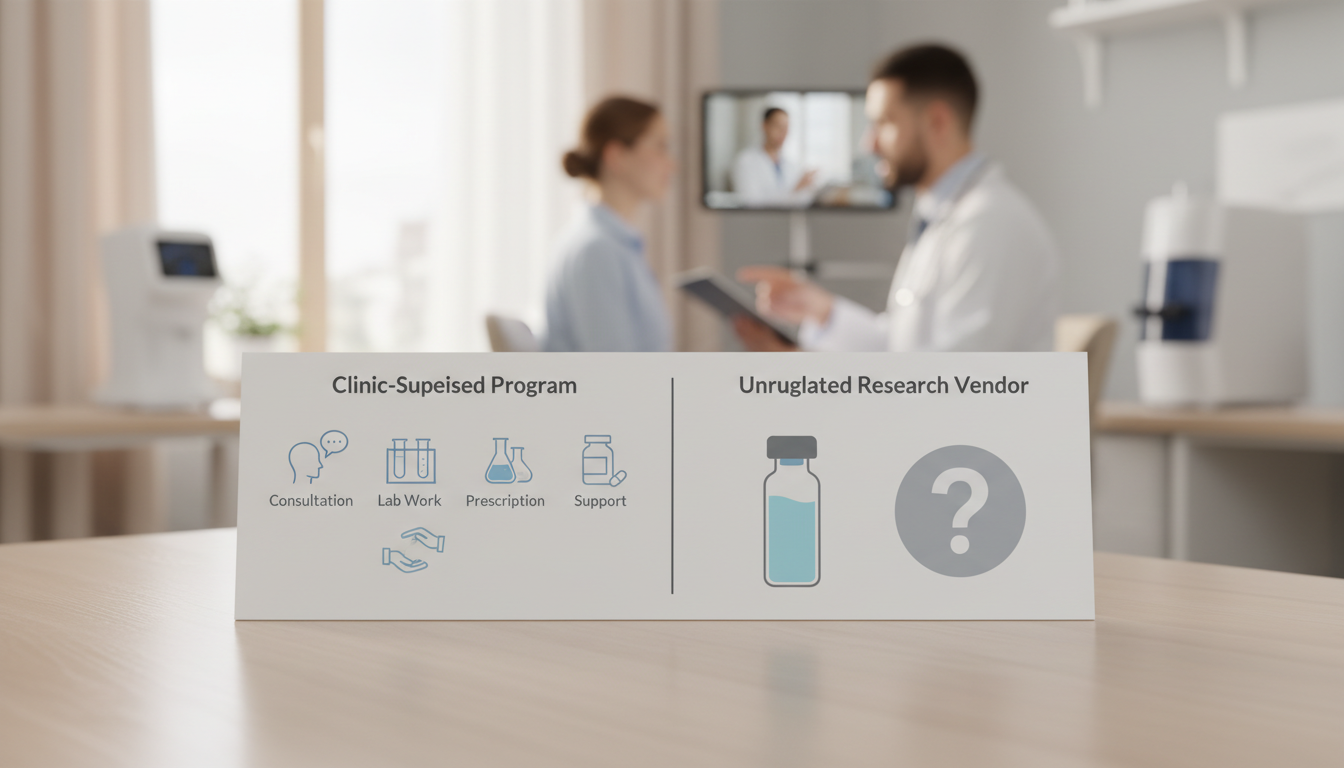
When you start looking into peptides, you’ll find two main paths: medically supervised clinics and online research vendors. Understanding the distinction is the single most important step in your process.
A performance clinic offers a structured, medically guided program. Here’s what that typically involves:
- Initial Consultation: You meet with a licensed clinician, often via telehealth, to discuss your health history, goals, and symptoms. This is a medical evaluation to determine if peptide therapy is appropriate and safe for you.
- Lab Work: Before prescribing anything, the clinic will order a blood panel. This establishes a baseline for key health markers and helps the provider create a suitable protocol.
- Prescription Medication: If you are a good candidate, the clinician writes a prescription. This prescription is sent to a licensed compounding pharmacy in the U.S. that is legally allowed to produce the peptide for human use.
- Ongoing Support and Monitoring: The clinic provides guidance on dosing, administration, and potential side effects. Follow-up appointments and sometimes further lab work are included to track your progress and adjust the protocol as needed.
This clinical approach provides a layer of safety, accountability, and professional guidance. You are a patient receiving medical care.
Online research vendors operate in a gray market. They sell peptides labeled "not for human consumption" and "for research purposes only." This labeling is a legal loophole. The products are not regulated by the FDA for purity, sterility, or dose accuracy. When you buy from a research vendor, you get:
- A vial of powder with no guarantee of what's inside.
- No medical consultation or lab work.
- No professional guidance on dosing or safety.
- No legal recourse if the product is contaminated or ineffective.
While the price tag for a research vial might seem lower, it's a completely different product. A 2026 report from PeakedLabs highlights that comparing these two is misleading because one is a raw, unregulated compound and the other is a complete medical service. While some peptides like Semaglutide are wildly popular, offered by 48% of clinics, others used for healing and performance like BPC-157 are also gaining traction, with 248 clinics offering them in the U.S. (PeptideClinicLocator).
Confused about where to start or how to find a legitimate peptide clinic? The process can feel overwhelming. Take our free 3-minute quiz to get matched with a vetted provider who can create a plan based on your specific goals.
Performance Clinics Peptides Review: Vetting Your Options in 2026
With nearly 5,000 peptide clinics now operating in the US, knowing how to choose a good one is critical. A slick website doesn’t guarantee quality care. When conducting your own performance clinics peptides review, use this checklist to vet potential providers.
1. Clinician Credentials and Expertise Who is designing your protocol? Look for clinics staffed by licensed Medical Doctors (MDs), Doctors of Osteopathic Medicine (DOs), or at least Nurse Practitioners (NPs) or Physician Assistants (PAs) working under a doctor's supervision. Ask about their experience with peptide therapy specifically. A provider who also specializes in hormone optimization or functional medicine is often more knowledgeable than one who simply added peptides as a side service. Don't be afraid to ask for credentials. If you're looking for guidance on this, our post on how to find a peptide doctor you can trust can help.
2. Sourcing and Pharmacy Transparency This is non-negotiable. The clinic MUST use state-licensed compounding pharmacies in the United States. Ask them to name their pharmacy partners. Reputable clinics are transparent about this. If they are vague or mention international sourcing, it is a major red flag. This ensures the peptides are subject to quality and safety standards. The February 2026 HHS announcement about potentially reclassifying peptides like BPC-157 directly impacts these licensed pharmacies, not gray market sellers.
3. Popular Peptides Offered for Performance and Healing While GLP-1s like Semaglutide and Tirzepatide dominate the market, a good performance clinic will offer a range of peptides for other goals. Some of the most common you'll see are:
- BPC-157 and TB-500: Often used together, these are the go-to compounds for injury recovery and are frequently used as healing peptides after surgery. They have extensive preclinical evidence for tissue repair, though human data for musculoskeletal injuries is still limited (The Peptide Effect). If you're considering these, explore our deep dive on BPC-157 vs. TB-500.
- CJC-1295 and Ipamorelin: This combination is used to naturally stimulate your body's own growth hormone production. It's popular for anti-aging, improving body composition, and enhancing sleep quality. It's known for having a good safety profile compared to synthetic HGH. For more details, see our CJC-1295 + Ipamorelin guide.
- Sermorelin: Another growth hormone secretagogue, Sermorelin has been around for decades and is one of the most widely adopted traditional peptides, offered by 777 clinics in the US (PeptideClinicLocator).
4. Comprehensive Lab Testing A quality clinic won't prescribe peptides blindly. They should require comprehensive blood work before starting treatment and periodically throughout. This protects your health and allows the provider to tailor the protocol effectively. If a clinic offers to send you peptides after a simple questionnaire with no lab work, proceed with extreme caution.
Cost Analysis: A Performance Clinics Peptides Review of 2026 Pricing
One of the biggest questions people have is about cost. The price of peptide therapy through a clinic can seem high, especially compared to the tempting prices on research sites. Let's break down what you're actually paying for.
According to a 2026 analysis, the all-in cost for peptide therapy programs generally ranges from $150 to $1,200 per month (PeptideClinicLocator). However, this is broken into initial and ongoing costs.
Initial Costs (First Month): $500 - $1,400+ This is the most expensive part of the process and includes:
- Initial Consultation: $150 to $500. This covers the provider's time for a detailed medical evaluation.
- Comprehensive Lab Panel: $150 to $400. This is the fee for the blood draw and analysis, which is crucial for safe and effective treatment.
- First Month of Medication: $200 to $500+. The cost of the actual prescribed peptide from a compounding pharmacy.
Ongoing Costs (Monthly): $150 - $600 After the first month, your costs typically drop to just the medication and any recurring membership or follow-up fees. For a specific example, compounded BPC-157 costs between $100 and $220 per month for the medication alone (PeptideClinicLocator). A full-service BPC-157 program, including clinical oversight, can run $425 or more per month (PeakedLabs).
Let's look at BPC-157 specifically. A "research" vial might cost $30-$120. A 4-week medically supervised program with BPC-157 can cost between $350 and $900 (PeakedLabs). The price difference reflects the entire clinical service: safety, physician expertise, legitimate medication, and a structured plan. The same logic applies to TB-500, where a 4-week clinic course can range from $325 to $850, a price that includes consultations and compounded medication, not just a raw vial (PeakedLabs).
Insurance generally does not cover compounded peptides for performance or anti-aging. However, if prescribed by a doctor for a specific medical condition, they may be eligible for payment with a Health Savings Account (HSA) or Flexible Spending Account (FSA).
Want to see which options fit your budget and goals? Our free quiz takes 3 minutes and matches you with vetted providers who offer transparent pricing.
The 2026 Legal & Regulatory Landscape: BPC-157, TB-500, and Compounding
The legal status of certain peptides is a critical topic in 2026. The FDA maintains lists that dictate which substances licensed pharmacies can and cannot compound. For a while, popular peptides like BPC-157 and TB-500 were placed on a list that restricted their use, causing supply issues and concern.
However, a significant development occurred in February 2026. The Secretary of Health and Human Services (HHS), Kennedy, announced that approximately 14 peptides, including BPC-157 and TB-500, could potentially return to "Category 1" status (Pure Peptide Clinic). This move would officially restore legal access for licensed compounding pharmacies to produce them upon prescription.
This is huge news for both patients and clinics. It promises to stabilize the supply chain and may lead to more competitive pricing among legitimate providers (PeakedLabs). It's important to understand this change only affects licensed compounding pharmacies. It does not legitimize the unregulated "research chemical" market.
This is especially relevant for those interested in healing peptides after surgery. With a clearer legal path, more physicians may feel comfortable prescribing compounds like BPC-157 to aid in tissue recovery. Despite its popularity and strong preclinical data, BPC-157 still has very limited human clinical trial data, with only two registered trials compared to over 4,300 for a drug like Semaglutide (Pure Peptide Clinic). This is why physician guidance is so important. Working with a clinic that stays on top of these regulations ensures you are receiving treatment that is both legal and sourced from a compliant pharmacy.
What to Consider Before Starting Peptide Therapy
Deciding to start peptide therapy is a significant health decision. Now that you've been through our performance clinics peptides review, here are the final points to consider.
First, clarify your goals. Are you trying to recover from an injury, improve body composition, slow aspects of aging, or something else? Your goal will determine which peptides are most appropriate, and a good clinician will help you navigate those choices. For example, someone seeking enhanced tissue repair might explore BPC-157, while someone focused on anti-aging might look at CJC-1295/Ipamorelin.
Second, commit to the process. Peptide therapy is not a one-time fix. It requires consistency, patience, and adherence to the protocol your provider creates. It also requires a financial commitment. Be realistic about the costs outlined above and budget accordingly.
Third, and most importantly, prioritize safety. The allure of cheap, unregulated peptides is strong, but the risks are real. Contamination, incorrect dosage, or impure substances can cause harm. Choosing a medically supervised program through a reputable performance clinic is the most responsible way to explore what peptides can do for you. These clinics are part of a growing industry, and finding a good one means you benefit from professional oversight.
Ready to explore your options safely? Take our free 3-minute quiz to get matched with a licensed provider who can help you achieve your health goals.
FAQs
Are performance peptide clinics legal and safe? Yes, clinics that employ licensed medical professionals who prescribe peptides from licensed U.S. compounding pharmacies operate legally. The safety comes from the medical oversight, lab testing, and use of regulated products, which you do not get from unregulated online vendors.
Does insurance cover peptide therapy from these clinics? Most health insurance plans do not cover compounded peptides for anti-aging, performance, or general wellness. However, the costs may be eligible for payment using an HSA or FSA if prescribed by a physician for a medical purpose. Always check with your insurance and plan administrator.
What is the difference between a research peptide and a compounded peptide? A compounded peptide is made to order for a specific patient by a state-licensed pharmacy under a doctor's prescription. It is subject to quality and safety regulations. A research peptide is sold online, often with a "not for human consumption" label, and is completely unregulated for purity, sterility, or dosage accuracy.
How much does a BPC-157 program cost at a clinic in 2026? A full BPC-157 program at a clinic typically costs between $350 and $900 for a 4-week course. This price includes the initial consultation, lab work, a month's supply of compounded BPC-157, and provider support. The medication itself may cost $200-$500 per month on an ongoing basis.
Can I get healing peptides after surgery from a performance clinic? Yes, many performance and longevity clinics prescribe peptides like BPC-157 and TB-500 to aid in recovery. You should always discuss this with your surgeon and the peptide clinic provider to ensure it is a safe and appropriate part of your post-operative care plan.
Contributing to evidence-based peptide education and provider transparency.
Too many clinics, not enough clarity?
We don't sell peptides. Tell us your goals and we'll connect you with a vetted provider who can figure out what actually makes sense for you.
See what's right for youRelated articles
How to Actually Find Peptide Therapy Near Me
Don't just Google "peptide therapy near me." Learn how to vet clinics, what questions to ask your doctor, and how to spot a trustworthy provider.
Provider GuideSigns of a Quality Peptide Compounding Pharmacy
Worried about quality? Learn the critical questions to ask any peptide compounding pharmacy, plus the red flags that signal you should stay away.
Provider GuideFinding Legit Peptide Clinics in the UK
Don't just Google 'peptide clinics uk'. Our guide shows you how to find a qualified provider, what to ask in a consult, and how to avoid scams.