What's a Typical CJC-1295 Dosage Per Week Look Like?
Wondering about your CJC-1295 dosage per week? Learn the critical difference between DAC and No DAC, see sample dosing schedules, and find the right protocol.
This content is for informational purposes only and does not constitute medical advice. Always consult with a qualified healthcare provider before starting any new treatment or therapy.
Finding the correct CJC-1295 dosage per week is one of the most common questions for anyone exploring peptide therapy for performance, anti-aging, or wellness. The answer, however, isn't a single number. It depends entirely on which version of the peptide you’re using. CJC-1295 is a synthetic analogue of growth hormone-releasing hormone (GHRH) designed to stimulate your pituitary gland to produce more growth hormone (GH). But it comes in two main forms that have drastically different dosing schedules.
This guide will break down the protocols for both versions of CJC-1295, explain the science behind why they're dosed differently, and provide the data-backed information you need to discuss this peptide with a healthcare provider. We'll cover the standard weekly doses for the long-acting version, the daily doses for the short-acting version often blended with Ipamorelin, and what current research from 2026 says about safety and effectiveness.
Understanding the Two Forms: CJC-1295 with DAC vs. without DAC
Before we can talk about a specific CJC-1295 dosage per week, you must first understand the fundamental difference between its two variations. The distinction comes down to a technology called Drug Affinity Complex, or DAC. The presence or absence of DAC completely changes the peptide’s half-life, which is the time it takes for half of the substance to be eliminated from your body. This directly impacts how often you need to administer it.
CJC-1295 with DAC: This is the long-acting version of the peptide. The DAC component allows the peptide to bind to a protein in your blood called albumin. This binding protects it from being broken down quickly, extending its half-life to about 6-8 days (PeptideVerdict, 2026). Because it remains active in the body for so long, it supports a sustained elevation of growth hormone and IGF-1 levels. Clinical studies from 2006 showed that a single injection could increase GH levels by 2 to 10 times for over six days and IGF-1 levels by 1.5 to 3 times for 9 to 11 days (The Peptide Report, 2026). This long duration of action is why protocols for this version are based on a weekly or twice-weekly injection schedule. If you are looking for a CJC-1295 dosage per week, you are looking for information on CJC-1295 with DAC.
CJC-1295 without DAC (also known as Mod GRF 1-29): This is the short-acting version. Without the DAC modification, the peptide is broken down very quickly in the body. Its half-life is only about 30 minutes (PeptideVerdict, 2026). This short duration means it creates a more natural, pulse-like release of growth hormone, similar to what your body does on its own. However, to maintain elevated GH levels, it requires more frequent injections, typically one to three times per day. This version is almost always paired with another peptide, like Ipamorelin, to create a synergistic effect. When you see protocols that mention daily injections, they are referring to this "no DAC" version, often in a blend like CJC-1295/Ipamorelin.
Confused about which version might be a better fit for your goals? The choice between a sustained release and a pulsed release is a key conversation to have with a medical professional. If you need help finding a qualified provider to discuss these options, our free quiz can help.
Take our free 3-minute quiz to get matched with a licensed provider who can help you determine the right approach. Find your provider match at /find-provider.

A Deep Dive into the CJC-1295 Dosage Per Week (with DAC)
Now, let's focus on the main topic: the correct CJC-1295 dosage per week. This protocol applies exclusively to the version with DAC due to its long half-life. Based on clinical research and a consensus among peptide specialists in 2026, the standard dosage range is clear and well-documented.
The typical dosage for CJC-1295 with DAC is between 1,000 mcg and 2,000 mcg (1 to 2 mg) per week (FormBlends, 2026; ThePeptideGuides, 2026). This total weekly amount is usually administered via subcutaneous injection.
How that weekly amount is divided can vary based on your provider’s protocol and your personal tolerance. Common administration schedules include:
- One 1,000-2,000 mcg injection once per week.
- Two 500-1,000 mcg injections twice per week (e.g., Monday and Thursday).
Dividing the dose into two smaller injections per week can help maintain more stable blood levels and may reduce the risk of side effects like flushing or headaches that can occur with a larger single dose.
Clinical research has established dose ranges based on body weight, typically from 30 mcg/kg to 60 mcg/kg (FormBlends, 2026). For a 175 lb (about 80 kg) person, this translates to:
- 30 mcg/kg: 30 mcg * 80 kg = 2,400 mcg (2.4 mg) per week
- 60 mcg/kg: 60 mcg * 80 kg = 4,800 mcg (4.8 mg) per week
These research doses are higher than what is typically used in a clinical wellness setting. Most providers will recommend starting on the lower end of the standard 1-2 mg weekly range and adjusting based on results and bloodwork. A common approach is to begin with 1 mg (1,000 mcg) per week and titrate up to 2 mg (2,000 mcg) over 4 to 6 weeks while monitoring IGF-1 levels and tolerance (PeptideClinicLocator, 2026).
A 2006 study noted that a single subcutaneous dose led to sustained GH and IGF-1 elevation for at least six and nine days, respectively, confirming the scientific basis for a weekly dosing schedule (FormBlends, 2026). This makes it a convenient option for those who prefer fewer injections compared to other growth hormone-releasing peptides.
Understanding CJC-1295 Ipamorelin Blends and Daily Dosing
While the primary keyword is CJC-1295 dosage per week, it is critical to address the other common protocol you will see online, which involves daily injections. This is where the secondary keyword, "cjc-1295 ipamorelin dosage per day in ml," becomes relevant. This specific question arises from the popularity of blending CJC-1295 with another peptide called Ipamorelin.
This popular combination uses the no-DAC version of CJC-1295. As we discussed, the no-DAC version has a very short 30-minute half-life, making a weekly dose ineffective. Instead, it must be taken daily to produce a therapeutic effect. The synergy comes from how the two peptides work. CJC-1295 (no DAC) stimulates a GH pulse, while Ipamorelin, a Ghrelin mimetic, amplifies that pulse and suppresses somatostatin, a hormone that blocks GH release. Read more about this specific blend in our CJC-1295 Ipamorelin guide.
The dosage for this blend is not measured weekly but daily. A protocol from Perfect B suggests a daily dose that escalates over time, starting around 0.6 mg per day in the first week and increasing to a maintenance dose of 2.0 mg per day by the third month. This is administered for a cycle of 1-3 months, followed by a break.
The question of dosage "in ml" depends entirely on how the peptide is reconstituted. Peptides come as a lyophilized (freeze-dried) powder and must be mixed with bacteriostatic water before injection. For example, if you have a 5 mg vial of CJC-1295/Ipamorelin and you add 2 mL of bacteriostatic water:
- The concentration is 5 mg / 2 mL = 2.5 mg per mL.
- To get a 0.6 mg dose, you would draw 0.6 mg / 2.5 mg/mL = 0.24 mL.
Calculating the correct volume in milliliters can be tricky. Using a dedicated reconstitution calculator is the best way to ensure accuracy. The key takeaway is that if you are taking a CJC-1295/Ipamorelin blend, you are almost certainly using the no-DAC version and will be injecting it daily, not weekly. For a complete breakdown, see our guide on the CJC-1295 Ipamorelin dosage per day.
Deciding between a weekly protocol with CJC-1295 with DAC or a daily protocol with a CJC-1295/Ipamorelin blend depends on your lifestyle, goals, and a provider's recommendation. Need help weighing the pros and cons and finding a provider who can source from a reputable pharmacy?
Our free quiz connects you with vetted providers in your area. Find the right expert for you by taking the quiz at /find-provider.
Cycle Length, Cost, and Legal Status in 2026
Beyond the dosage, there are practical considerations like cycle length, cost, and legality to understand before starting a CJC-1295 protocol. These factors are crucial for planning and managing expectations.
Typical Cycle Length
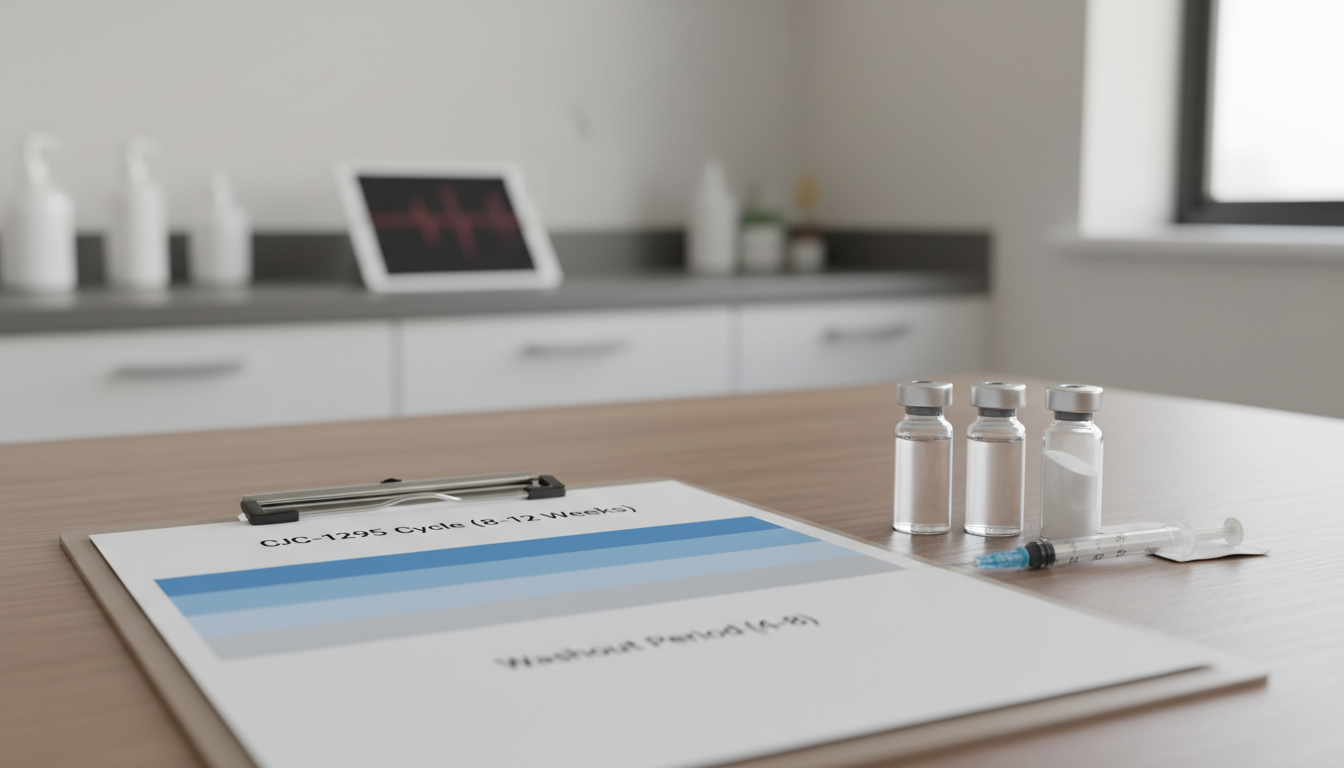
You should not take CJC-1295 indefinitely. To prevent receptor desensitization and allow your body to reset, protocols typically involve cycles of use followed by periods of rest. For CJC-1295 with DAC, a common cycle length is 8 to 12 weeks of use, followed by a 4 to 8 week "washout" period (FormBlends, 2026). This off-cycle helps ensure the peptide remains effective over the long term. Your provider will determine the best cycle for you based on your response and bloodwork, particularly your IGF-1 levels.
Expected Costs
The cost of peptide therapy can vary significantly. For CJC-1295 with DAC, the monthly cost when prescribed by a doctor from a compounding pharmacy generally ranges from $150 to $300 as of 2026 (FormBlends, 2026). Costs can differ based on your dosage, the pharmacy, and the clinic's administrative fees. For those purchasing the peptide for non-clinical research purposes, prices can range from $3.75 to $10.00 per milligram (PeptideVerdict, 2026). Comparing the cost of peptide therapy across different providers is an important step.
Legal and Regulatory Status
The legal status of CJC-1295 has been a point of confusion. As of early 2026, CJC-1295 is not an FDA-approved medication for any condition (RegenTherapy, 2025). It remains an investigational compound.
However, its status for compounding has changed. In 2023, the FDA placed it on a list of substances that could not be compounded, but this decision was met with pushback. In February 2026, both versions of CJC-1295 were reinstated and can once again be legally prescribed by licensed physicians and compounded by FDA-registered pharmacies (FormBlends, 2026; PeptideVerdict, 2026). It is classified as a "Category 1" peptide, meaning it is eligible for compounding.
It is crucial to note that it is banned by the World Anti-Doping Agency (WADA), making it unsuitable for competitive athletes subject to testing (FDA-2024-N-4777-0002). Always source peptides from a reputable peptide clinic online or in-person to ensure you are receiving a legitimate, high-quality product.
What to Consider with Your CJC-1295 Dosage Per Week
Before starting any peptide protocol, especially one involving a CJC-1295 dosage per week, there are several important factors to discuss with a healthcare provider. This is not a treatment to begin without professional guidance.
First and foremost, consultation with a qualified doctor is essential. They can assess your health history, conduct baseline blood tests (especially for IGF-1), and determine if you are a suitable candidate. Self-prescribing is risky, as incorrect dosing or underlying health issues could lead to unwanted outcomes.
Potential side effects, while generally mild and temporary, should be monitored. Short-term studies have noted side effects like headaches, nausea, flushing at the injection site, and flu-like symptoms (The Peptide Report, 2026). These are often dose-dependent and can be managed by starting with a lower dose and slowly titrating up.
Finally, managing expectations is key. While clinical data shows impressive increases in GH and IGF-1, individual results can vary. Benefits like improved body composition, better sleep, and enhanced recovery happen over months, not days. Working with a provider helps you track progress and make adjustments to your protocol for the best possible results.
Final Thoughts
Determining the right CJC-1295 dosage per week depends on using the long-acting version with DAC, typically dosed at 1,000 to 2,000 mcg weekly. If you're considering a blend with Ipamorelin, you'll be on a daily dosing schedule with the short-acting (no DAC) version. Understanding this distinction is the most important step in having an informed discussion with your healthcare provider.
This peptide remains an investigational compound without FDA approval, but its availability through compounding pharmacies under a doctor's care makes it an accessible option for many in 2026.
Ready to explore your options with a professional? The next step is to connect with a licensed provider who specializes in hormone optimization and peptide therapy.
Take our free 3-minute quiz to get matched with a top-rated clinic or provider who can design a plan for your specific health goals.
FAQs
What is the typical weekly dosage for CJC-1295 with DAC?
The standard CJC-1295 dosage per week for the long-acting version (with DAC) is 1,000 to 2,000 mcg (1 to 2 mg). This is typically administered as one or two subcutaneous injections per week.
Can I take CJC-1295 and Ipamorelin together?
Yes, but this blend almost always uses the short-acting version of CJC-1295 (no DAC). Because of its short half-life, this combination requires a daily injection schedule, not a weekly one. The dosage is often calculated daily and may escalate over the first few months of use.
Do I need to cycle CJC-1295?
Yes, it is generally recommended to cycle CJC-1295 to prevent your body's growth hormone receptors from becoming less sensitive. A common cycle involves 8 to 12 weeks of use followed by a 4 to 8 week break.
Is CJC-1295 legal in 2026?
CJC-1295 is not an FDA-approved drug. However, as of February 2026, it was reinstated for use by compounding pharmacies. This means a licensed physician can legally prescribe it, and a registered compounding pharmacy can prepare it for you.
What are the common side effects of CJC-1295?
The most common side effects are generally mild and may include headaches, nausea, flu-like symptoms, and temporary flushing or irritation at the injection site. These effects are often related to the dosage and may lessen as your body adapts or with a lower dose.
Contributing to evidence-based peptide education and provider transparency.
Too many clinics, not enough clarity?
We don't sell peptides. Tell us your goals and we'll connect you with a vetted provider who can figure out what actually makes sense for you.
See what's right for youRelated articles
Popular Peptides for Men & What They're Used For
From BPC-157 for healing to CJC-1295 for growth, we explain the most common peptides for men and how they could benefit your health and fitness goals.
Growth HormoneDo Peptide Injections for Muscle Growth Actually Work?
Considering peptide injections for muscle growth? We explain the science, the most popular stacks, and the real risks vs. benefits for building lean mass.
Growth HormoneWhat Does Human Growth Hormone Actually Do for You?
Curious about human growth hormone? We explain how this vital hormone works, its role in metabolism, and why it's so debated for anti-aging and performance.