What's the Real Difference in Cost vs Price?
The sticker price is rarely what you actually pay. We break down cost vs price to help you see how hidden fees, time, and effort affect the true cost.
This content is for informational purposes only and does not constitute medical advice. Consult with a qualified healthcare professional before making any decisions about your health or treatment.
When you look at a new medication or treatment, the first thing you probably see is a number with a dollar sign. That’s the price. But what you actually end up paying, in both money and effort, is the cost. Understanding the difference between cost vs price is one of the most important things you can do to take control of your healthcare in 2026. The price is a single number, but the true cost is a story that unfolds over months or even years, especially with modern treatments like GLP-1 medications for weight loss.
This year, the weight loss medication market has been completely shaken up, with new options and aggressive pricing making headlines. But a lower sticker price doesn't always mean a lower total cost. Factors like effectiveness, side effects, insurance coverage, and availability all play a huge role in what a treatment will ultimately demand from your wallet and your life. We'll break down the cost vs price debate using the latest 2026 data on popular GLP-1s to help you see beyond the price tag.
Quick Comparison: Price vs. Cost
Before we dive deep, let's get a clear overview. The terms are often used interchangeably, but they represent very different concepts.
| Feature | Price | Cost |
|---|---|---|
| Definition | The amount of money charged for a product or service. | The total resources given up to obtain and use a product or service. |
| What it Is | A single, specific number (e.g., $399/month). | A comprehensive calculation (e.g., Price + Time + Side Effects + Additional Care). |
| Example | The list price of Mounjaro is around $1,080/month. | The actual cost could be $25/month with a savings card or over $18,000 across 18 months without insurance. |
| Timeframe | A snapshot at one point in time. | A long-term view, measured over the entire duration of treatment. |
| Key Question | "How much do I have to pay right now?" | "What is the total impact of this decision over time?" |
| Analogy | The sticker price of a car. | The total cost of owning the car, including gas, insurance, maintenance, and repairs. |
What is Price?
Price is simple. It's the number on the label, the amount the pharmacy tells you a medication sells for. In the world of pharmaceuticals, this is often called the "list price" or "cash price." For example, research from 2026 shows the manufacturer list price for Mounjaro is between $1,069 and $1,080 per month (Healthfactsjournal.com, 2026). Similarly, the new higher-dose Wegovy HD launched with a cash-pay price of $399 per month (Bioreview.com, 2026).
These are prices. They are fixed points of data. However, they rarely tell the whole story. Think of it like a software subscription. The Planswift cost might be a certain amount per year for the license. That's its price. But this figure doesn't account for the hours your team needs to spend learning it, which is part of its total cost.
The price of a medication is the starting line, not the finish line. It's the number that gets headlines, but it's not the number that most people actually pay, and it certainly doesn't reflect the full value exchange. The initial Nexplanon cost, for instance, might look high, but because it lasts for three years, its long-term cost can be much lower than paying for birth control pills every month. This shows how focusing only on price can be misleading.
What is Cost?
Cost is the bigger, more important picture. It’s the total value you give up for a treatment. This includes the price you pay out-of-pocket, but it also includes non-financial factors. The difference between cost vs price is what you should focus on when making a health decision with your provider.
The true cost of a medication includes:
- Out-of-Pocket Price: The actual dollars that leave your bank account after insurance, copay cards, and discounts.
- Time and Convenience: How much time do you spend going to appointments, dealing with insurance, or administering the treatment?
- Side Effects: The "cost" of managing side effects can include buying other medications, missing work, or a lower quality of life.
- Effectiveness: An ineffective but cheap medication has a very high cost, because you spent money and time for no result.
- Additional Medical Needs: Does the treatment require frequent lab tests or follow-up appointments? That's part of the cost.
For example, the cost of a treatment plan can vary wildly. One analysis showed that an 18-month course of tirzepatide (the active ingredient in Mounjaro and Zepbound) could cost as little as $450 for someone with great insurance or over $18,000 for an uninsured person paying retail (Healthfactsjournal.com, 2026). Both people are getting the same drug, but their costs are worlds apart. It's like the hospital delivery cost for having a baby; the final bill includes much more than just the room charge.
Confused about how insurance, your health history, and your goals affect the true cost of your options? You're not alone. Take our free quiz to get matched with a provider who can help explain the best path for you.
A Deep Dive into Cost vs Price in Medicine
Understanding this distinction is vital for anyone managing their health. The sticker price is an advertisement, but the total cost is your reality. Let's look at the key differences more closely.
Scope and Inclusions
The price is one-dimensional. It is a single data point. The cost is multi-dimensional. It's a formula that looks something like this:
Total Cost = (Out-of-Pocket Price) + (Cost of Time) + (Cost of Side Effects) - (Value of Positive Outcomes)
A medication with a low price but severe side effects could have a very high total cost. Conversely, a medication with a high price that prevents a costly surgery has a very low total cost. The jltv cost, the price for a new military vehicle, is just the start. The total cost of ownership includes decades of fuel, parts, and maintenance. Your healthcare choices work the same way.
The Impact of Payment Method
Nowhere is the cost vs price difference more obvious than when looking at how a drug is paid for. In 2026, the landscape of GLP-1 payments is complex.
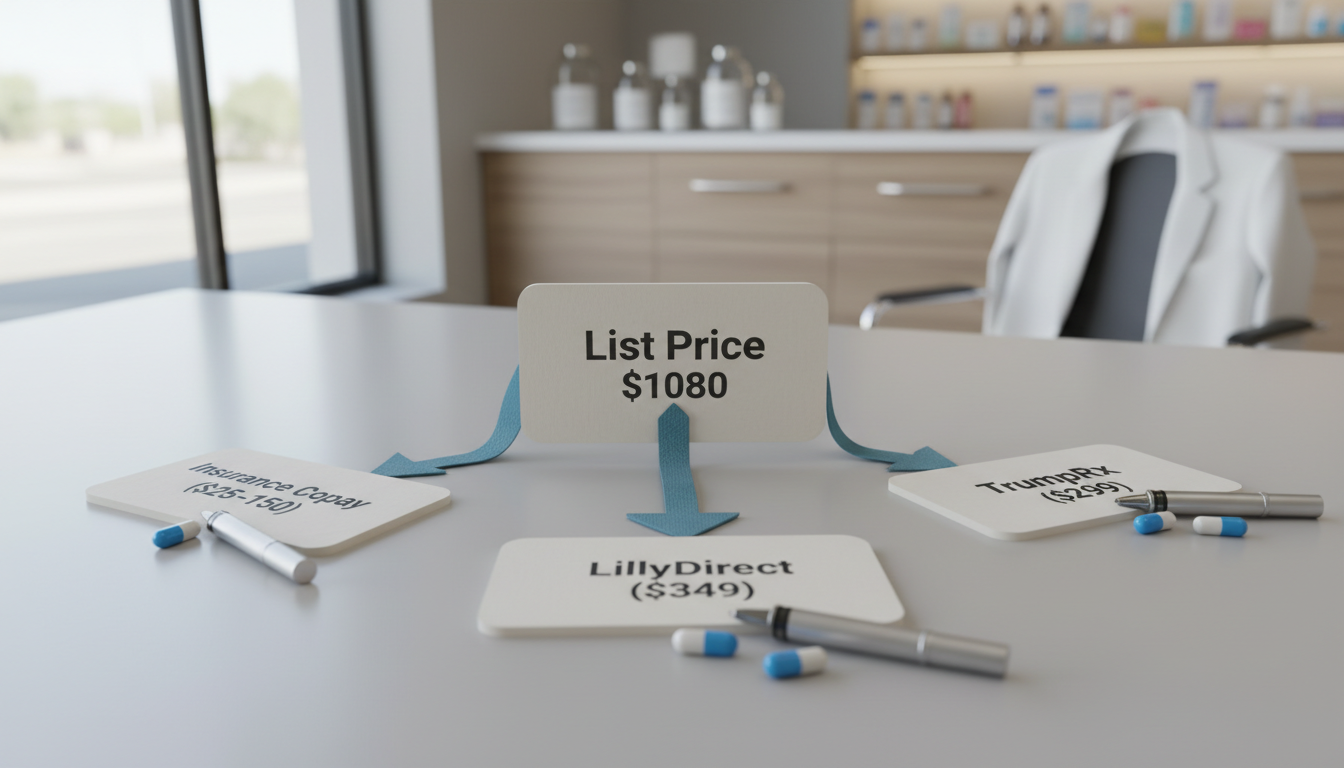
- Commercial Insurance: With good commercial insurance and a manufacturer savings card, the cost for drugs like Mounjaro or Ozempic can be as low as $25 per month (Healthfactsjournal.com, 2026; Formblends.com, 2026). The list price is over $1,000, but the cost to the patient is minimal.
- Manufacturer Direct Programs: Eli Lilly's LillyDirect program is a major development. For weight loss, it offers Zepbound for a self-pay price that is significantly lower than retail. One source notes this price is around $349/month, a steep discount from the list price over $1,000 (Healthfactsjournal.com, 2026).
- Discount Portals: New federal portals like TrumpRx, launched in February 2026, provide "cash" prices that can be even lower. The site listed Zepbound for $299 (a 72% discount) and the new oral Wegovy pill for $149 (an 89% discount). These prices often don't apply to your deductible, so it's a trade-off (ThePricer.org, 2026).
The list price is rendered almost meaningless by these different pathways. Your true cost depends entirely on which path you can access. The Vercel cost for hosting a website isn't just the monthly subscription, but the development time saved. Likewise, the cost of a drug isn't its price, but what you pay after finding the best discount program.
Wegovy HD vs. Zepbound: A 2026 Cost vs Price Breakdown
To make this real, let's compare two of the leading injectable weight loss drugs of 2026: Novo Nordisk's new Wegovy HD (semaglutide 7.2 mg) and Eli Lilly's Zepbound (tirzepatide).
The big news in April 2026 was Novo Nordisk's launch of Wegovy HD. This higher-dose formulation was approved by the FDA on March 19, 2026, and was strategically priced to compete directly with Lilly (Quantisnow.com, 2026).
-
The Price War: Wegovy HD launched with a cash-pay price of $399 per month. This was a direct shot at Zepbound's injectable, which was priced around $449 per month at the time (Bioreview.com, 2026). On price alone, Wegovy HD has a slight edge for the self-pay patient. This was part of a larger market shift that also saw oral GLP-1 pills from both companies launch at an even lower price point of $149 per month.
-
The Cost of Efficacy: A cheaper price is worthless if the product doesn't work. Here, the competition is fierce. The STEP UP trial for Wegovy HD showed a mean weight loss of 20.7% in people with obesity (Quantisnow.com, 2026). This is remarkable, as it puts the efficacy of semaglutide in the same league as tirzepatide for the first time. Clinical data for tirzepatide has shown similar, and in some studies slightly higher, weight loss percentages. Since both drugs now offer around 21% average weight loss, the "cost per percentage point of weight loss" is very close, making the price difference a more important factor.
-
The Cost of Access: Price is one thing, but accessibility is another. Zepbound is available through LillyDirect, and its price can be as low as $299 through portals like TrumpRx. Wegovy's pricing is aggressive at $399, but patients will need to see what discounts and programs become available through Novo Nordisk. For patients with great insurance, the cost might be identical at a $25 copay for either drug, making the decision about which one works better for them personally, not which one has a lower list price.
Feeling overwhelmed by the different prices and programs for medications like semaglutide and tirzepatide? Our free quiz can help you find a provider who can navigate these options with you.
Side Effects and the Total Cost of Care
A drug's side effect profile is a critical part of its total cost. If a medication makes you feel sick, you might miss work, spend money on remedies, or even stop the treatment altogether, wasting all the money you've already spent.
Both semaglutide (Wegovy, Ozempic) and tirzepatide (Zepbound, Mounjaro) are GLP-1 medications and share a similar class of side effects. The most common are gastrointestinal.
| Common Side Effect | Semaglutide (Wegovy, Ozempic) | Tirzepatide (Zepbound, Mounjaro) | Cost Implication |
|---|---|---|---|
| Nausea | Very common, especially when starting or increasing dose. | Very common, often reported as slightly less frequent or intense than semaglutide by some users. | Buying anti-nausea medication, lost productivity, discomfort. |
| Diarrhea | Common. | Common. | Discomfort, potential for dehydration, buying hydration drinks or medication. |
| Vomiting | Common. | Common. | Risk of dehydration, missed work, significant discomfort. |
| Constipation | Common. | Common. | Buying laxatives or fiber supplements, discomfort. Learn more about Ozempic constipation. |
| Fatigue | Often reported. | Often reported. | Lower productivity, impact on daily activities. |
While the side effect profiles are similar, individual experiences can vary. For some, one drug may be intolerable while the other is manageable. The ability to find the right medication for your body is a major factor in the total cost of care. A drug you can't tolerate has an infinite cost because it provides zero benefit. This is why discussing these potential issues with your peptide therapy clinic is so important.
Deciding Between Options: Who Is Each For?
With the new pricing and options available in 2026, patients have more choices than ever. Applying the cost vs price framework can help clarify the decision.
The Budget-Conscious Self-Payer
For this person, the sticker price is the primary concern.
- Best Option: The new oral GLP-1s, like Lilly's Foundayo (orforglipron), are the clear winners. At an introductory price of $149 per month, they offer an accessible entry point into GLP-1 therapy (PR Newswire, 2026). While the weight loss may be less than the high-dose injectables (around 12.4% for Foundayo), the price is unbeatable.
- Alternative: If a higher-efficacy injectable is needed, the decision between Wegovy HD ($399) and Zepbound (as low as $299) is a matter of hunting for the best deal. The low Adipex cost might also be tempting as an older alternative, but its lower efficacy and different side effect profile may lead to a higher overall cost for a worse result.
The Efficacy-Focused Patient with Good Insurance
For this person, the goal is the best possible result, and the cost is what matters. Since their out-of-pocket price is likely a low, fixed copay (e.g., $25), the sticker price is irrelevant.
- Best Option: The choice is between the highest-efficacy injectables, Wegovy HD 7.2 mg and the highest dose of Zepbound. The decision should be based on clinical results and a provider's guidance. Since both now show around 21% weight loss, the choice might come down to individual tolerance of side effects or which drug their insurance covers more favorably. You can read more about the differences in our Semaglutide vs Tirzepatide guide.
The Patient Prioritizing Convenience
For this person, the "cost" of their time and effort is a major factor.
- Best Option: Oral GLP-1 pills are the obvious choice. Lilly's Foundayo is unique because it's the only one that can be taken any time of day, without restrictions on food or water (investor.lilly.com, 2026). This convenience dramatically lowers the "time cost" of treatment compared to daily or weekly injections, which require storage, preparation, and administration. You can learn more about the Wegovy oral pill here.
Ready to Find Your Path?
The world of health treatments is complex, and the difference between cost and price is at the heart of that complexity. Making the right choice requires looking beyond the price tag to understand the total impact on your life and finances.
Ready to explore your options with a professional? Take our free 3-minute quiz to get matched with a licensed provider who can help you understand the true cost of your treatment choices and find the best fit for your goals and budget.
FAQs
What is the main difference between cost and price in healthcare?
Price is the sticker amount for a service or drug, like a $1,000 list price for a monthly prescription. Cost is the total amount you actually pay, including money, time, and managing side effects, which could be as low as a $25 copay or as high as the full list price plus other expenses.
Is a lower price always better for a medication?
No. A lower-priced medication may be less effective, have more severe side effects, or require more frequent dosing, all of which increase its total cost. The goal is to find the lowest cost for the best outcome, not just the lowest price.
How can I find the real cost of my medication in 2026?
To find your true cost, you need to check your insurance formulary, search for manufacturer savings programs (like the Novo Nordisk Savings Card or Lilly's savings programs), check prices on direct-to-patient platforms like LillyDirect, and use price-check tools like the new TrumpRx portal. Most importantly, discuss these options with your healthcare provider.
Are compounded GLP-1s still a low-cost option in 2026?
The situation has changed. As of 2026, compounded tirzepatide is no longer legally available because the brand-name versions, Mounjaro and Zepbound, are not on the FDA's drug shortage list (Healthfactsjournal.com, 2026). Compounded semaglutide, however, may still be available from licensed compounding pharmacies as a lower-price alternative, often starting from $200-$400 per month (Formblends.com, 2026). You can learn more about finding a cheapest tirzepatide compounding pharmacy for when supplies are legally available.
Contributing to evidence-based peptide education and provider transparency.
Too many clinics, not enough clarity?
We don't sell peptides. Tell us your goals and we'll connect you with a vetted provider who can figure out what actually makes sense for you.
See what's right for youRelated articles
A Step-by-Step Gelatin Recipe for Weight Loss
Seen the viral "pink trick"? We break down the simple gelatin recipe for weight loss. Learn our step-by-step method to help manage hunger and feel full.
GLP-1 Weight LossOzempic Cost in 2026: What You'll Actually Pay
The 2026 Ozempic cost can be anywhere from $25 to over $1,400 a month. Discover why and learn how to find savings with or without insurance coverage.
GLP-1 Weight LossHow Zep Weight Loss Works and What to Expect
Thinking about zep weight loss? We cover how this drug works, what realistic results look like, common side effects, and how it compares to Ozempic.