What's the Proper GHK-Cu Peptide How To Use?
Trying to figure out GHK-Cu peptide how to use? We break down the exact steps for mixing the powder, drawing the correct dose, and where to apply it.

This content is for informational purposes only and does not constitute medical advice.
GHK-Cu, also known as copper peptide, has become a hot topic for its potential benefits in skin repair, hair growth, and anti-aging. It’s a naturally occurring peptide that our bodies produce less of as we age. But if you’ve decided to explore its use, you likely have one big question: "What is the proper GHK-Cu peptide how to use protocol?" This guide will walk you through the process, from mixing the peptide to administering it, while covering the essential safety information you need.
It's critical to understand that injectable GHK-Cu is not approved by the FDA for any medical use, and its compounding is restricted (PeptidesExplorer, 2026). You should always work with a qualified healthcare provider who can guide you.
What You'll Need
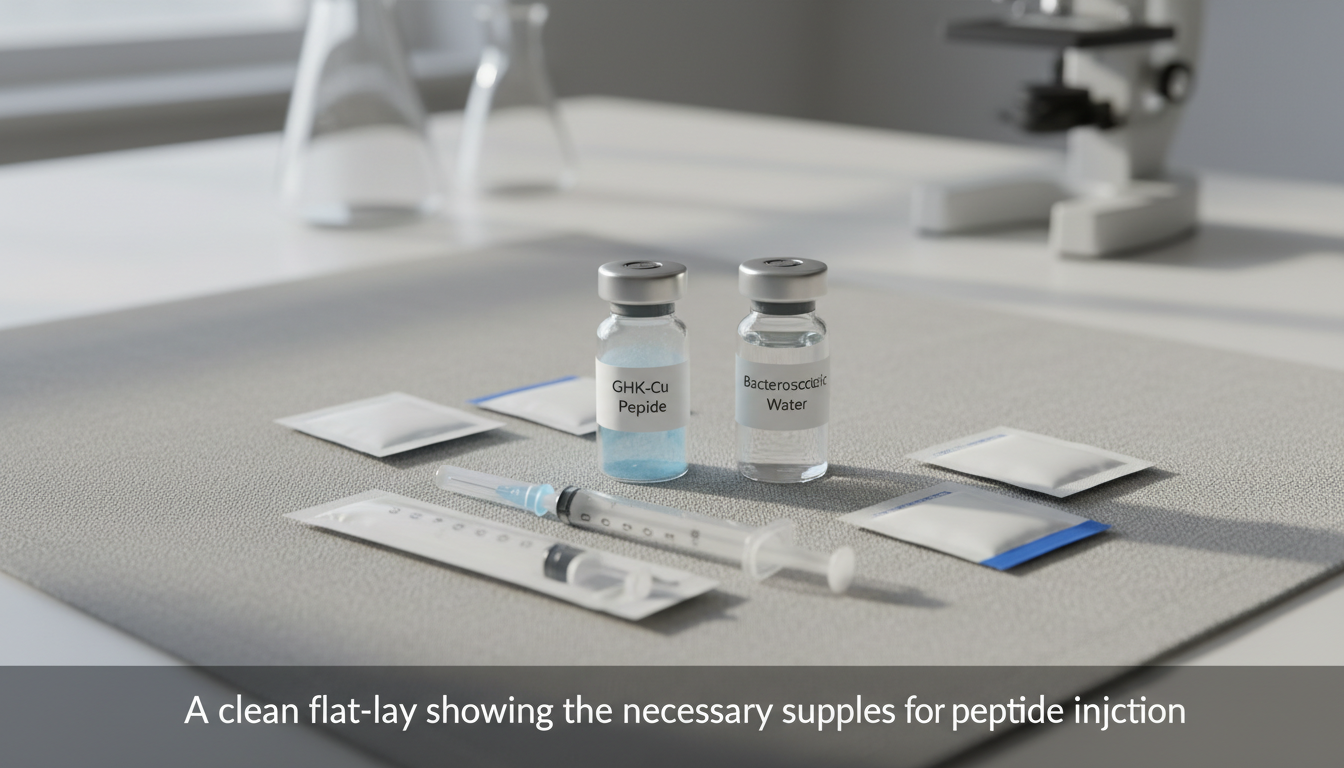
Before you begin, you need to gather the correct supplies. Using sterile, appropriate equipment is non-negotiable for safety. Here is a basic checklist of items typically required for subcutaneous GHK-Cu injections.
- Lyophilized GHK-Cu: The peptide comes as a dry, pressed powder in a sealed vial. Common vial sizes are 10mg, 50mg, and 100mg.
- Bacteriostatic Water: This is sterile water containing 0.9% benzyl alcohol, an agent that prevents bacterial growth. It is used to reconstitute (mix) the peptide powder.
- Insulin Syringes: These are small syringes, typically 0.3ml, 0.5ml, or 1ml, with a fine-gauge needle for subcutaneous injections.
- Alcohol Prep Pads: Used to sterilize the top of the vials and the injection site to prevent infection.
Having all your supplies organized on a clean surface makes the process safer and more efficient.
Before You Start: Essential Context
Understanding GHK-Cu peptide how to use it correctly goes beyond just the injection process. There are critical details about dosing, legality, and different administration routes you must grasp before you begin.
First, let's talk about the status of GHK-Cu. The FDA has not approved it as a drug. Topical formulations are sold as cosmetic products, but injectable versions exist in a regulatory gray area. In March 2024, it was banned from the compounding nomination list and later classified as Category 2, which restricts its compounding by 503A pharmacies (Peptide Injections AI, 2026; PeptidesExplorer, 2026). This means sourcing it requires careful vetting. You can learn more about finding a reputable source in our guide on where to get GHK-Cu peptide injections safely.
Next is dosage. For subcutaneous injections, a common protocol is 1-2 mg (1,000-2,000 mcg) per day (FormBlends, 2026). Some practitioners suggest cycling its use, for example, injecting for 4 to 12 weeks followed by a break of at least 4 weeks to prevent potential copper accumulation (the "Cu" in GHK-Cu stands for copper). For topical use, serums with a 1-3% concentration applied once or twice daily are standard.
Why choose one method over the other? Topical applications are excellent for surface-level skin improvements like wrinkle reduction and improving skin elasticity, with human clinical studies supporting this use (The Peptide Effect, 2026). Injectable GHK-Cu provides systemic effects, meaning it circulates throughout your body and may offer benefits for internal tissue repair and inflammation.
Not sure which peptides or protocols are the right fit for your health goals? A qualified provider can help you create a plan. Take our free quiz to get matched with a provider who understands peptide therapy.
Step-by-Step Instructions for GHK-Cu Peptide: How to Use It Safely
Following a precise, sterile procedure is vital for safety and effectiveness. This section breaks down everything from mixing your vial to the final injection.
Step 1: Reconstitute the GHK-Cu Vial
Your GHK-Cu will arrive as a solid, chalky powder. You must mix it with bacteriostatic (BAC) water before use. This process is called reconstitution.
- Prepare your vials: Remove the plastic caps from both the GHK-Cu vial and the BAC water vial. Use an alcohol prep pad to wipe the rubber stoppers on top of each vial.
- Draw the water: Take a new syringe and draw the required amount of BAC water. The amount of water you add will determine the final concentration of your solution. For example, adding 2mL of BAC water to a 100mg vial of GHK-Cu creates a concentration of 50mg per mL.
- Add the water to the peptide: Insert the needle of the syringe into the GHK-Cu vial, angling it so the water runs down the side of the glass instead of spraying directly onto the powder. This prevents damaging the delicate peptide molecules. Inject the water slowly.
- Mix gently: Do not shake the vial. Instead, gently roll it between your fingers or swirl it until the powder is completely dissolved and the solution is clear. Shaking can break down the peptide.
Calculating doses for peptides can be complex. While we're focused on GHK-Cu, users of other peptides for different goals, like weight management, often need a specialized tool. For instance, a 60mg tirzepatide peptide reconstitution calculator is essential for accurately dosing that specific compound. For GHK-Cu, our free peptide reconstitution calculator can help you determine the right measurements for any vial size and desired concentration.
Step 2: Calculate Your Dose
Once your GHK-Cu is reconstituted, you need to calculate the exact volume for your desired dose. This requires some simple math. The key is to know your solution's concentration (in mg/mL or mcg/mL) and the dose you need (in mg or mcg).
Example Calculation:
- You have a 50mg vial of GHK-Cu.
- You reconstituted it with 5mL of BAC water.
- Your concentration is 50mg / 5mL = 10mg per 1mL.
- Your target dose is 1mg.
To find the volume, you can use this formula:
- (Target Dose / Concentration) = Injection Volume
- (1mg / 10mg per mL) = 0.1mL
On a standard 1mL insulin syringe (U-100), 1mL is equal to 100 units. Therefore, 0.1mL is equal to 10 units. You would draw the solution up to the 10-unit mark on the syringe for a 1mg dose. Be very careful to distinguish between milligrams (mg) and micrograms (mcg). A 1mg dose is the same as a 1000mcg dose. Double-checking your math is the most important part of this step.
Step 3: Choose and Prepare an Injection Site
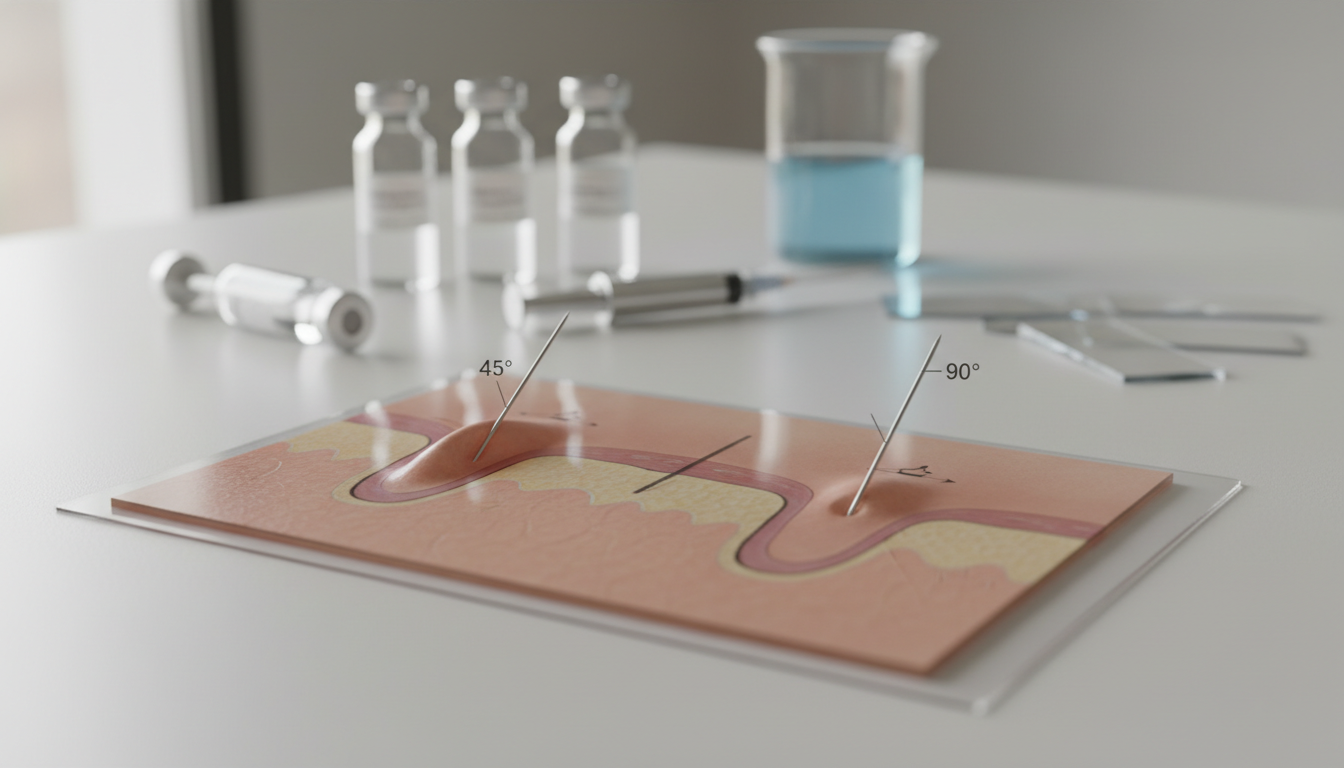
GHK-Cu is administered via subcutaneous injection, which means it goes into the fatty tissue just beneath the skin. This allows for slow, steady absorption.
Common injection sites include:
- The abdomen: At least two inches away from the belly button.
- The upper outer thigh: Where there is a good amount of fatty tissue.
- The glute (upper outer quadrant): This can be harder to reach on your own.
It is critical to rotate your injection sites. Using the same spot repeatedly can cause lipohypertrophy, which is a buildup of fatty tissue, or irritation and scarring. A good practice is to create a mental map of your abdomen or thighs and move to a new spot with each injection, keeping each new site at least one inch away from the last. For a detailed visual guide, see our post on where to inject peptides. Before every injection, thoroughly clean the selected area with a new alcohol prep pad and let it air dry completely.
Step 4: Draw Your Dose into the Syringe
With your injection site clean and your peptide reconstituted, it's time to draw your calculated dose into the syringe.
- Equalize pressure: Pull the syringe plunger back to the mark of your target dose (e.g., 10 units for 0.1mL). This fills the syringe with air.
- Inject air into the vial: Turn the GHK-Cu vial upside down. Insert the needle through the rubber stopper and push the plunger to inject the air into the vial. This step makes it much easier to draw the liquid out, as it prevents a vacuum from forming.
- Draw the GHK-Cu: With the vial still upside down, slowly pull the plunger back past your target dose mark.
- Remove air bubbles: Keep the syringe pointed up and gently tap the side to make any air bubbles rise to the top. Slowly push the plunger to eject the air bubbles until the top of the black plunger is perfectly aligned with your dose mark.
- Double-check the dose: Look at the syringe at eye level to confirm you have the correct amount before removing the needle from the vial.
Step 5: Administer the Subcutaneous Injection
You are now ready to administer the injection.
- Pinch the skin: At your prepared injection site, use your non-dominant hand to gently pinch a one to two-inch fold of skin and fat.
- Insert the needle: With your dominant hand, hold the syringe like a dart. Insert the needle quickly and confidently into the pinched skin. You can go in at a 90-degree angle (straight in) if you can pinch two inches of skin, or a 45-degree angle if you are leaner and can only pinch one inch.
- Inject the peptide: Slowly push the plunger all the way down until the syringe is empty. The typical blue or dark color of GHK-Cu solution may cause a temporary blueish spot under the skin, which is normal.
- Withdraw the needle: Wait a few seconds before pulling the needle out at the same angle you inserted it. Release the pinch of skin.
- Apply pressure: You can gently press on the site with a clean cotton ball or gauze, but do not rub the area. A small amount of bleeding or a tiny blue dot is common.
- Dispose of the syringe: Immediately place the used syringe into an FDA-cleared sharps disposal container.
Step 6: Proper Storage After Use
Proper storage is essential to maintain the peptide's stability and sterility.
- Unreconstituted Vials: Lyophilized GHK-Cu powder is stable at room temperature for short periods but should be stored in a refrigerator (not freezer) for long-term storage before mixing. Keep it away from direct light.
- Reconstituted Vials: Once you have mixed GHK-Cu with bacteriostatic water, it must be kept in the refrigerator. The benzyl alcohol in the BAC water will keep it sterile for about 28 days (FormBlends, 2026). After this period, any remaining solution should be discarded to avoid contamination or loss of potency.
Label your vial with the date of reconstitution so you know when it expires. Never use a peptide solution that appears cloudy or has particles floating in it.
Common Mistakes to Avoid
Even with instructions, mistakes can happen. Knowing what to watch out for can save you from wasting product and prevent side effects. Here are some of the most common errors when learning GHK-Cu peptide how to use.
- Incorrect Reconstitution: Adding too little water makes the solution overly concentrated and hard to dose accurately. Adding too much dilutes it, requiring a larger injection volume. Following a reconstitution calculator is the best way to avoid this.
- Shaking the Vial: Peptides are fragile protein chains. Vigorously shaking a vial can damage the molecules, rendering the peptide less effective. Always swirl or roll gently.
- Improper Storage: Leaving a reconstituted vial at room temperature can cause it to degrade quickly and allows for potential bacterial growth. Always refrigerate it.
- Ignoring Cycling: Some protocols suggest cycling GHK-Cu to prevent the body from building up excess copper. Continuous, long-term use without breaks is not recommended without clinical supervision, as long-term safety data is limited (The Peptide Effect, 2026).
- Poor Injection Technique: Reusing needles, not cleaning the site, or injecting into muscle instead of fat can lead to infection, bruising, pain, and improper absorption.
- Combining Incompatible Topicals: If using a topical GHK-Cu serum, avoid applying it at the same time as low-pH products like Vitamin C (ascorbic acid). The acidity can destabilize the copper peptide and make both products less effective (PeptidesExplorer, 2026).
Feeling overwhelmed by the options and protocols? You're not alone. Our free quiz takes 3 minutes and matches you with vetted providers who can help you find a safe and effective plan.
When to Contact Your Doctor
While GHK-Cu is generally well-tolerated, you should always be in communication with a healthcare provider. Contact your doctor immediately if you experience any of the following:
- Signs of an allergic reaction: This can include hives, rash, severe itching, difficulty breathing, or swelling of the face, lips, tongue, or throat. These reactions are rare but require immediate medical attention.
- Severe injection site reactions: Some mild redness, itching, or bruising at the injection site can be normal. However, if you experience significant pain, swelling, warmth, or discharge that persists or worsens, it could be a sign of infection.
- Systemic side effects: Though uncommon with standard doses, report any unusual symptoms like persistent nausea, dizziness, or headaches to your provider.
Before you start any new peptide therapy, it's essential to discuss your health history, including any known conditions like Wilson's disease (a copper metabolism disorder), with a medical professional. You can find qualified providers in your area through RxFox's directory of peptide therapy clinics.
Ready to take the next step with guidance from a professional? Take our free 3-minute quiz to get matched with a licensed provider who can help you determine if GHK-Cu is right for you and create a customized plan.
FAQs
What is the best time of day to inject GHK-Cu?
There is no medical consensus on the optimal time to inject GHK-Cu. Some users prefer the morning to align with the body's natural healing cycles, while others choose the evening. The most important factor is consistency, so choose a time that you can stick with daily.
Can I mix GHK-Cu with other peptides like BPC-157 in the same syringe?
Mixing different peptides in the same syringe is generally not recommended unless specifically directed by your healthcare provider. Peptides can have different pH levels and stability requirements, and mixing them could compromise their effectiveness or cause unwanted reactions. It is safest to inject them separately. You can learn more about peptides like BPC-157 on our site.
How long does it take to see results from GHK-Cu?
Results vary by individual and the method of administration. With topical use, some users report improvements in skin hydration and texture within a few weeks, while significant changes in wrinkles and collagen density can take three months or more (Peptidedosingprotocols.com, 2026). With injectable use, systemic benefits like reduced inflammation may be felt sooner, but visible skin and hair changes will still take several weeks to months to become apparent.
Is injectable GHK-Cu legal?
Injectable GHK-Cu is not an FDA-approved drug. It is sold for research purposes, and the FDA has restricted its compounding in certain pharmacies. While it is accessible, its use should be under the guidance of a knowledgeable medical provider who can source it from a reputable place.
What are the main side effects of GHK-Cu?
The most common side effect is injection site reaction, including temporary pain, redness, itching, or a blueish discoloration from the peptide itself. Some users experience a slight "sting" during injection. Systemic side effects are rare at typical doses but can include nausea or lightheadedness. Individuals with copper metabolism disorders like Wilson's disease should not use GHK-Cu.
Contributing to evidence-based peptide education and provider transparency.
Too many clinics, not enough clarity?
We don't sell peptides. Tell us your goals and we'll connect you with a vetted provider who can figure out what actually makes sense for you.
See what's right for youRelated articles
How Protein and Muscle Growth Actually Work
It's not just about eating more. Understand the real science of protein and muscle growth to learn how much you need and the best timing to see results.
Peptide ScienceWhat are the best peptides for muscle growth and fat loss?
Exploring peptides for muscle growth and fat loss? Discover the most effective options for body recomposition, how they actually work, and what to expect.
Peptide ScienceThe Key L-Lysine Benefits for Skin, Immunity & Stress
Discover the science-backed l-lysine benefits. Our guide covers how this essential amino acid may boost collagen, fight viruses, and aid calcium absorption.