Where to Get GHK-Cu Peptide Injection Safely
Trying to find where to get GHK-Cu peptide injection? This guide explains how to get a prescription and how to spot unsafe research-only sellers.
This content is for informational purposes only and does not constitute medical advice.
The world of peptide therapy is filled with promising compounds, and GHK-Cu is one of the most talked-about for skin, hair, and overall vitality. If you are trying to figure out where to get GHK-Cu peptide injection, you are not alone. This powerful copper peptide has gained a reputation for its regenerative abilities, but finding a safe and legal source can feel confusing. This guide will walk you through the process, explain the current landscape in 2026, and help you understand your options for accessing this therapy.
An Introduction to GHK-Cu Peptides
GHK-Cu is a small, naturally occurring peptide complex made of three amino acids (a tripeptide) bound to a copper ion. Your body produces it naturally, but levels decline significantly with age. This decline is linked to some of the visible signs of aging and slower tissue repair.
The main job of GHK-Cu is to regulate gene expression. It can influence thousands of human genes, essentially resetting them to a younger, healthier state. This action supports the body's built-in repair processes, antioxidant defenses, and collagen production. For this reason, it has become a popular topic in the anti-aging peptide therapy community.
While GHK-Cu is widely available in topical cosmetic products, the injectable form is sought after for its systemic effects, affecting the body from the inside out. However, its status is complex. Injectable GHK-Cu is not approved by the FDA for these uses. It is available through some specialized telehealth clinics that issue prescriptions to licensed U.S. compounding pharmacies. This is a critical distinction to understand as you explore your options.
Where to Get GHK-Cu Peptide Injection Online in 2026
The most common and legitimate way to get GHK-Cu injections in 2026 is through an online telehealth platform specializing in hormone optimization and peptide therapy. These clinics connect you with licensed medical providers who can evaluate your health and determine if a prescription is appropriate for you.
Here’s how the process generally works:
- Consultation: You complete an online intake form and have a virtual consultation with a doctor or nurse practitioner.
- Prescription: If you are a good candidate, the provider writes a prescription.
- Pharmacy Fulfillment: The prescription is sent to a licensed 503A compounding pharmacy in the U.S.
- Shipment: The medication, along with all necessary supplies like syringes and alcohol pads, is shipped directly to your home.
Several platforms offer this service. Based on publicly available information in 2026, here are a few examples:
- BeyondMD: Offers GHK-Cu injections for systemic support of skin and tissue quality. Their program starts at $239 and is presented as a way to enhance recovery and vitality, with effects typically seen in 2 to 4 weeks (BeyondMD).
- Team Wellcore: Provides GHK-Cu as a prescription-only peptide after a full evaluation with one of their providers. Their program costs $239 (plus an initial $34 consultation charge) and focuses on gradual, layered change over 3 to 12-week assessment periods (Team Wellcore).
- Powered By Peptides: Includes a medical consultation with a U.S. board-certified physician. They note that GHK-Cu is a primary ingredient in popular "GLOW" and "KLOW" protocols designed for rejuvenation (Powered By Peptides).
These clinics work with pharmacies like Spectrum Medical and Phoenix Meds Inc., which compound the GHK-Cu. Spectrum Medical, for instance, prepares it as a 5mg peptide in a 5 mL vial under sterile standards, while Phoenix Meds Inc. offers a 50mg multi-dose vial, both requiring a prescription (Spectrum Medical, Phoenix Meds Inc.).
Finding the right provider can feel overwhelming. If you want help sorting through your options, a matching service can simplify the process.
Feeling unsure which telehealth clinic is the best fit? Our free quiz can help you find a vetted provider that aligns with your health goals. Take the 3-minute quiz now.
The Regulatory Landscape and Why It's Complicated
When you search for where to get GHK-Cu peptide injection, you will likely find conflicting information. It is essential to understand the regulatory context to make a safe decision.
First, injectable GHK-Cu is not approved by the U.S. Food and Drug Administration (FDA) for anti-aging, skin rejuvenation, or hair growth. This means it has not gone through the large-scale clinical trials required for commercial drugs like Mounjaro or Ozempic. Because of this, it exists in a complex regulatory space.
Some sources claim GHK-Cu was banned from compounding in March 2024 (Peptide Injections AI). However, as of 2026, numerous telehealth clinics continue to offer it through prescriptions filled at licensed 503A compounding pharmacies. This suggests a "regulatory grey area" where its availability depends on specific pharmacy licenses and interpretations of compounding laws (MyPeptideMatch).
This is why you will see two very different types of sellers online:
- Telehealth Clinics: These are legitimate medical platforms. They require a doctor's consultation and a prescription. The GHK-Cu they provide is made in a regulated pharmacy for human use.
- "Research Chemical" Websites: These sites sell peptides with a disclaimer that they are "for laboratory use only" and "not for human consumption." Buying from these sources is risky. The products are not intended for human administration, and there are no guarantees of their purity, sterility, or even what they contain.
To ensure your safety, the only recommended path is to work with a licensed medical provider. They can help you find a legitimate peptide clinic and source medication from a reputable compounding pharmacy that adheres to strict quality standards.

Costs, Dosage, and Other Popular Peptides
Before starting any new therapy, it’s practical to understand the potential costs, what a typical protocol looks like, and how it compares to other peptides.
GHK-Cu Cost in 2026
Since GHK-Cu is a compounded medication and not FDA-approved, insurance does not cover it. You should expect to pay out-of-pocket. The peptide price can vary, but here’s a general breakdown based on 2026 data:
- Monthly Cost: Most GHK-Cu programs from telehealth clinics range from $200 to $400 per month. For example, both BeyondMD and Team Wellcore list their GHK-Cu programs at $239.
- Compounded Range: Industry analysis shows that the cost for a monthly supply from a compounding pharmacy generally falls between $80 and $250, but this doesn't include the cost of the consultation, supplies, and provider support that are part of a full program (MyPeptideMatch).
What Research Shows About Dosage
There is no FDA-approved dosing protocol for GHK-Cu. Dosages are determined by the prescribing physician based on clinical experience and research literature. In research settings, typical subcutaneous injection doses range from 1 to 2 mg per administration, often on a daily or every-other-day schedule (PeptideClinicLocator).
Many providers start patients on a lower "titration" dose, such as 0.5 mg, and gradually increase it over several weeks to assess tolerance. It is critical to follow the exact protocol provided by your doctor and not rely on anecdotal information from online forums. Some people search for a "glow protocol peptide dosage chart pdf reddit," but using unverified information can be unsafe. A personalized protocol from a medical professional is the only reliable source.
Related Peptides and Protocols
GHK-Cu is often discussed alongside other peptides. Understanding them can help you have a more informed conversation with your doctor.
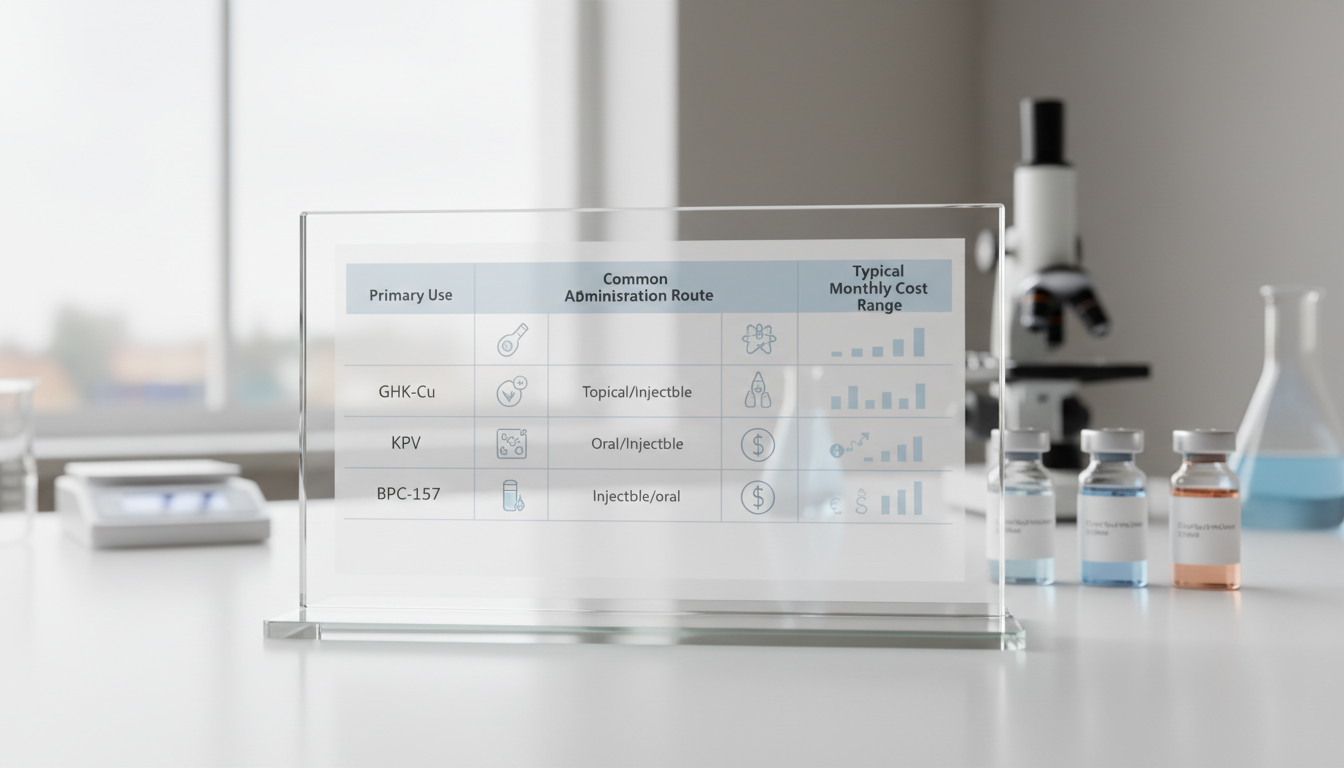
- KPV Peptide: This is another tripeptide known for its potent anti-inflammatory effects. Many online KPV peptide reviews highlight its benefits for soothing skin irritation and supporting gut health. Like GHK-Cu, it is sourced via prescription from compounding pharmacies.
- BPC-157: A peptide famous for its systemic healing and tissue repair properties. It is often used for injuries but also has benefits for skin and gut health. You can learn more about it in our guide to BPC-157 peptide injections. While GHK-Cu is a tripeptide, BPC-157 is larger, but users interested in recovery often explore both.
- 5-Amino Peptide Benefits: This search term likely refers to pentapeptides (peptides with five amino acids), which are common in cosmetic topicals for stimulating collagen. However, in the context of injectables, users may be looking for peptides that offer broad regenerative benefits, a category where GHK-Cu and BPC-157 are leaders.
- PT-141 (Bremelanotide): If you've wondered where to get PT-141 peptide, the process is identical to GHK-Cu. It's a prescription peptide available through telehealth clinics, but it's used for improving sexual function, not skin health.
Confused about which peptide protocol is right for your goals, whether it's skin health, recovery, or something else? Take our free quiz to get matched with a provider who can build a plan for you.
What to Consider Before Starting GHK-Cu
Starting a new therapy requires careful consideration. Here are a few final points to discuss with your provider before deciding if GHK-Cu is right for you.
A medical consultation is not optional; it's a requirement for safety. A provider will screen you for contraindications. For instance, individuals with copper metabolism disorders like Wilson's disease should not use GHK-Cu (Powered By Peptides).
It is also important to set realistic expectations. GHK-Cu works from the inside out to support your body's natural biology. It is not a direct replacement for fillers or Botox, which offer immediate, localized results. Instead, GHK-Cu promotes gradual, layered changes. Providers often assess progress over 3 to 12-week windows (Team Wellcore). Before and after photos can be subtle at first, with improvements in skin texture, tone, and healing speed appearing over time.
The medication comes as a lyophilized (freeze-dried) powder that you must reconstitute with bacteriostatic water. Your provider will give you instructions, and you can use a reconstitution calculator to ensure accuracy. Once mixed, the vial must be stored in the refrigerator. Injections are typically administered subcutaneously, a simple process you can learn in our guide on where to inject peptides.
For other popular options like GLP-1 agonists, similar sourcing questions arise. For a simple peptide like Tirzepatide, where to buy follows the same model. It is best and most safely sourced through a telehealth clinic that provides a prescription from a licensed provider. You can find more information in our overview of the best Tirzepatide compounding pharmacies.
Ready to see if GHK-Cu or another peptide therapy is right for you? It starts with a conversation. Take our free 3-minute quiz to get matched with a licensed U.S. provider who can help guide your next steps.
FAQs
Where can I get a GHK-Cu peptide injection legally? The most common legal route in 2026 is through a telehealth medical clinic. A licensed provider can evaluate you and, if appropriate, write a prescription for GHK-Cu that is filled by a U.S. compounding pharmacy and shipped to your home.
How much do GHK-Cu injections cost in 2026? The cost for a monthly supply of injectable GHK-Cu from a telehealth provider typically ranges from $200 to $400. This price usually includes the medication, supplies, and medical support. Insurance does not cover GHK-Cu as it is not an FDA-approved drug.
Is GHK-Cu approved by the FDA? No, injectable GHK-Cu is not approved by the FDA for any medical or cosmetic use. It is available as a compounded medication prescribed "off-label" by a licensed physician.
What are the main benefits of GHK-Cu peptides? Research and clinical use suggest GHK-Cu may help stimulate collagen and elastin, improve skin firmness and elasticity, promote wound healing and tissue repair, reduce inflammation, and support hair growth by enlarging hair follicles.
How long does it take to see results from GHK-Cu? Results are gradual and vary by individual. Some users report noticing initial effects like improved skin hydration and healing within 2 to 4 weeks. More significant changes in skin texture, firmness, and hair vitality are typically assessed over a 3 to 12-week period.
Contributing to evidence-based peptide education and provider transparency.
Too many clinics, not enough clarity?
We don't sell peptides. Tell us your goals and we'll connect you with a vetted provider who can figure out what actually makes sense for you.
See what's right for youRelated articles
How Protein and Muscle Growth Actually Work
It's not just about eating more. Understand the real science of protein and muscle growth to learn how much you need and the best timing to see results.
Peptide ScienceWhat are the best peptides for muscle growth and fat loss?
Exploring peptides for muscle growth and fat loss? Discover the most effective options for body recomposition, how they actually work, and what to expect.
Peptide ScienceThe Key L-Lysine Benefits for Skin, Immunity & Stress
Discover the science-backed l-lysine benefits. Our guide covers how this essential amino acid may boost collagen, fight viruses, and aid calcium absorption.