What's the Proper MGF Peptide Dosage for Bodybuilding?
Find the effective MGF peptide dosage for bodybuilding. We break down dosing schedules, cycle examples, and the key differences between PEG-MGF and base MGF.

This content is for informational purposes only and does not constitute medical advice. Always consult a qualified healthcare professional before starting any new treatment or supplement regimen.
For athletes focused on building serious muscle, recovery is just as important as the workout itself. This has led many to explore advanced tools for repair and growth. One such tool creating a buzz is Mechano Growth Factor, or MGF. If you're looking for a clear guide on the MGF peptide dosage for bodybuilding, you've come to the right place. We'll break down the types of MGF, what the research says about dosing, and the critical safety information you need to know.
While many supplements support muscle synthesis, MGF is unique. It’s an isoform, or variant, of Insulin-like Growth Factor 1 (IGF-1) that is expressed in response to mechanical stress on muscle tissue, like a tough lifting session. Its primary role is to activate satellite cells, which are the stem cells of your muscles, kicking off the repair and growth process. This link between muscle damage and growth is fundamental, a topic we explore deeply in our guide to how protein and muscle growth work.
This guide will walk you through the key differences between standard MGF and its more stable cousin, PEG-MGF, and explain how those differences impact dosing strategies for your fitness goals.
What is MGF and How Does It Work?
Mechano Growth Factor (MGF) is a specific version of IGF-1 that your body produces locally in muscle tissue after it's been damaged or stressed. Think of it as the first responder after a heavy set of squats or bench presses. When muscle fibers tear, your body releases MGF to signal for help. Its main job is to activate satellite cells, which are dormant cells waiting on the sidelines. Once activated, these cells multiply and fuse to existing muscle fibers, helping them repair and grow larger. This process is called hypertrophy, and it's the foundation of muscle building.
There are two primary forms of MGF you'll encounter in research circles, and their differences are crucial for understanding dosage:
-
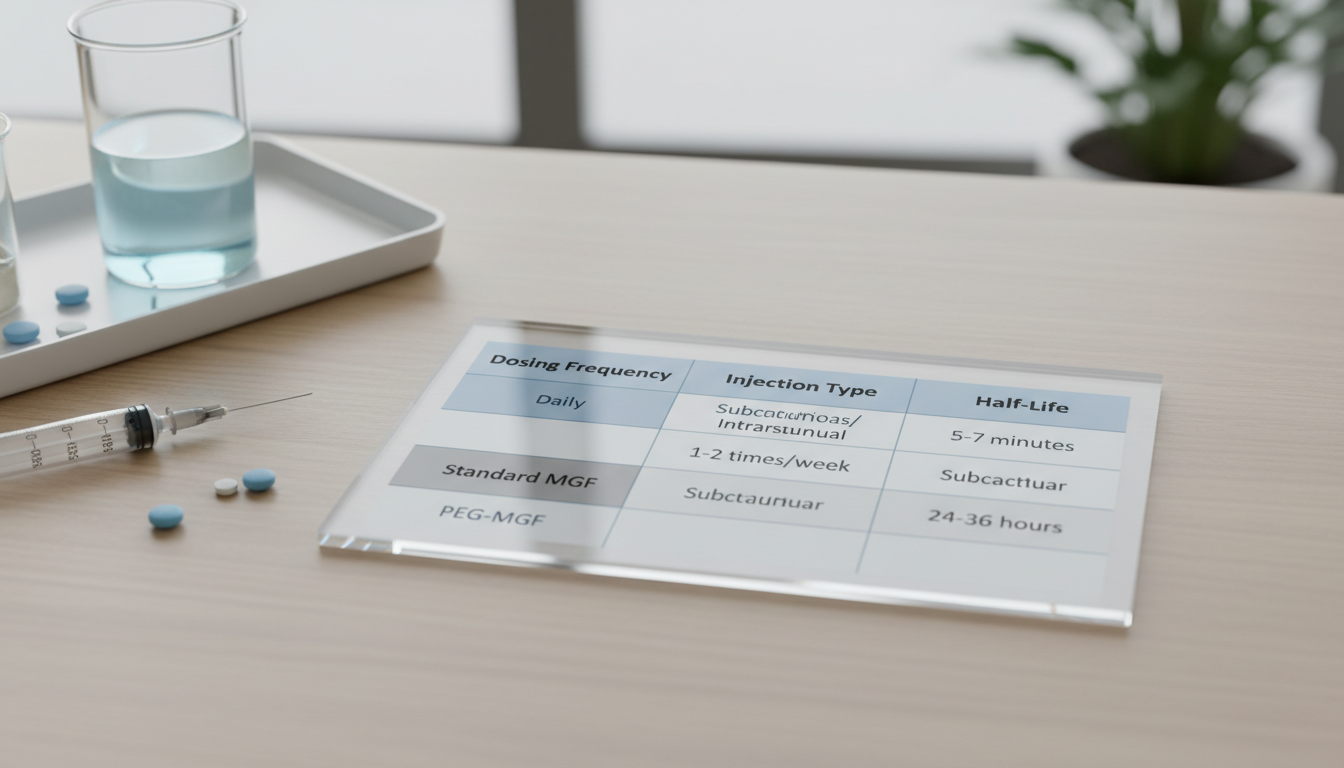
Standard MGF: This is the base form of the peptide. Its structure is very similar to what the body naturally produces. However, it has a major practical limitation. Its half-life is extremely short, lasting only about 5-7 minutes in the body (Peptides Insider, allaboutpeptides.com). This means it degrades very quickly, making it difficult to use effectively. To get any localized benefit, research protocols often involve injecting it directly into the muscle that was just trained, almost immediately after the workout is finished.
-
PEG-MGF: To solve the half-life problem, researchers developed PEG-MGF. "PEG" stands for Polyethylene Glycol. This is a process called PEGylation, where a molecule of polyethylene glycol is attached to the peptide. This shield protects the MGF from being broken down so quickly by enzymes in the bloodstream. The result is a dramatically extended half-life, stretching from minutes to as long as 48-96 hours (allaboutpeptides.com, peptidecliniclocator.com). This stability makes PEG-MGF a much more practical compound for research, as it can be administered less frequently and circulates systemically, meaning it doesn't necessarily need to be injected into a specific muscle to have an effect.
Because of these differences, the administration and dosing protocols for standard MGF and PEG-MGF are completely different. Standard MGF is used for a quick, localized pulse, while PEG-MGF provides a sustained release. Most of the interest and research in bodybuilding communities now focuses on PEG-MGF due to its longer-lasting effects and more convenient dosing schedule. MGF is one of many peptides for muscle growth and fat loss that researchers are studying.
Not sure which peptides might align with your personal health and fitness goals? Answering a few simple questions can help point you in the right direction. Take our free quiz to see what options might be a fit for you and get matched with a provider.
A Guide to MGF Peptide Dosage, Bodybuilding Cycles, and Timing
Navigating the correct MGF peptide dosage for bodybuilding requires understanding which form of the peptide you are using. The protocols for standard MGF and PEG-MGF are distinct due to their vastly different half-lives. It's also critical to remember that neither compound is approved by the FDA for human use, so these dosage guidelines are based on preclinical research and anecdotal reports from the fitness community, not established clinical trials (Peptide Clinic Locator).
Standard MGF Dosing Protocol
Because standard MGF has a half-life of only a few minutes, timing and placement are everything. The goal is to deliver the peptide directly to the stressed muscle tissue immediately after training to capitalize on the open window for satellite cell activation.
- Dosage: Research protocols typically suggest doses between 200–400 mcg per administration (Peptides Insider).
- Administration: This form is almost always injected intramuscularly (IM) directly into the muscle that was just trained. For example, after a chest workout, it might be administered into the pectoral muscle. A general guide on peptide injection therapy can provide more context on different injection techniques.
- Timing: Injections are done within 30 minutes post-workout to coincide with the natural spike in local growth factors.
- Frequency: Due to its targeted, acute nature, it is only administered on training days, typically 2-3 times per week.
A protocol from My Peptide Match suggests a tiered approach, starting with 100 µg three times weekly post-workout for the first couple of weeks before increasing to 200 µg for the remainder of a cycle.
PEG-MGF Dosing Protocol
PEG-MGF is the more commonly discussed variant due to its extended stability. The longer half-life (48-96 hours) allows for more flexible and less frequent administration.
- Dosage: Dosing for PEG-MGF generally falls within the 100-500 mcg range per injection. A common starting protocol might involve 100-150 mcg injected twice weekly (Peptide Initiative). More standard or advanced protocols often use 200-400 mcg administered 2-3 times per week (allaboutpeptides.com, Peptides Insider). Some sources suggest a gradual titration, starting at 50-100 mcg and increasing every few weeks to find a maintenance dose (Peptide Clinic Locator).
- Administration: PEG-MGF is typically injected subcutaneously (SC), meaning into the fatty layer under the skin, usually in the abdomen. This allows it to enter the bloodstream and circulate throughout the body. Some protocols still suggest intramuscular (IM) injections into trained muscles, but SC is more common due to the peptide's systemic nature (Peptide Initiative).
- Timing: Because of its long half-life, precise timing is less critical than with standard MGF. Many protocols suggest administering it on recovery days to support the repair process, while others administer it post-workout. It's generally given 2-3 times per week on non-consecutive days to maintain stable blood levels.
- Cycle Length: Research cycles for both MGF and PEG-MGF typically last between 4 and 8 weeks (Peptides Insider, Peptide Clinic Locator). It is often recommended to take at least 4 weeks off between cycles to prevent receptor desensitization.
When considering supplements for muscle growth, it's helpful to see how they compare. MGF works directly on satellite cells, while other popular aids like creatine supplements for muscle growth function by increasing energy availability within the muscle cell.
Reconstitution, Storage, and Practical Considerations
Before any peptide can be used, it must be properly prepared. MGF, like most research peptides, is sold as a lyophilized (freeze-dried) powder in a sterile vial. To use it, you must reconstitute it with a diluent, typically bacteriostatic water. Proper handling and storage are essential to maintain the peptide's integrity.
How to Reconstitute MGF
Reconstitution is the process of mixing the powder with a sterile liquid to prepare it for injection. The amount of water you add will determine the final concentration of the peptide per unit on an insulin syringe.
- Gather Your Supplies: You will need your vial of MGF, a vial of bacteriostatic water, alcohol swabs, and a larger syringe for mixing (e.g., a 3mL syringe).
- Prepare the Vials: Swab the rubber stoppers of both the peptide vial and the bacteriostatic water vial with an alcohol pad.
- Draw the Water: Use the mixing syringe to draw the desired amount of bacteriostatic water. A common amount is 2.0 mL or 3.0 mL. For example, reconstituting a 2mg (2000mcg) vial of PEG-MGF with 2.0 mL of water yields a concentration of 1000 mcg/mL. A 5mg MGF vial reconstituted with 3.0 mL of water gives a concentration of roughly 1.67 mg/mL, where 1 unit on a U-100 syringe equals about 16.7 mcg (peptidedosages.com).
- Mix the Solution: Slowly and gently inject the bacteriostatic water into the MGF vial, aiming the stream of water against the side of the glass wall to avoid foaming. Do not shake the vial. Gently swirl or roll it between your hands until the powder is fully dissolved.
Using a peptide reconstitution calculator can simplify this math and help you determine the exact volume needed for your target dose.
Storage Guidelines
Proper storage is non-negotiable for preserving the peptide's effectiveness.
- Before Reconstitution: Lyophilized MGF powder should be stored in a freezer at around -20°C for long-term stability or in a refrigerator at 2-8°C (36-46°F) for short-term storage (Peptides Insider).
- After Reconstitution: Once mixed, the liquid MGF solution must be kept refrigerated at 2-8°C (36-46°F). Do not freeze it. Most sources suggest using the reconstituted peptide within 14-28 days for maximum potency (Peptide Clinic Locator). Always check the expiration date and look for any changes in color or clarity, which could indicate degradation.
Want to explore which peptide options might fit your goals and budget? Our free quiz takes just a few minutes and connects you with vetted providers who can offer guidance based on your specific needs. Take our free 3-minute quiz to get started.
Understanding the Risks and Legal Status of MGF
While the potential benefits of MGF for muscle repair are intriguing, it's essential to have a clear-eyed view of the risks, side effects, and legal landscape. The most important fact to understand is that MGF and PEG-MGF are not approved by the FDA for human use (allaboutpeptides.com). They are classified as research compounds and are not legal to sell for human consumption.
Furthermore, the World Anti-Doping Agency (WADA) prohibits the use of MGF in competitive sports. This places it in the same category as anabolic steroids and other performance-enhancing drugs.
Potential Side Effects
Because there are no large-scale human clinical trials, the full side effect profile of MGF is not well understood. The information available comes from preclinical studies and anecdotal reports. Reported side effects include:
- Injection Site Reactions: Redness, soreness, itching, or a small lump at the injection site is the most common side effect.
- Hypoglycemia: Since MGF is related to IGF-1, it may have a slight effect on blood sugar, potentially causing it to drop. This is a risk to be aware of, especially for individuals with diabetes or metabolic conditions.
- Headaches: Some users report experiencing headaches, particularly with higher doses.
- Systemic Growth: There is a theoretical concern that long-term use of growth factors could promote the growth of unwanted cells. The long-term effects of MGF use are unknown (Peptide Initiative).
When exploring peptides, it's wise to research the specific side effect profile for each one. For instance, with another popular cosmetic peptide, users often have questions about ghk cu peptide side effects hair loss, which is a concern specific to that compound. You can read more about the pros and cons of GHK-Cu to understand how different peptides carry different risk profiles. Similarly, the intended use dictates the dosage. MGF's focus is muscle growth, which is a stark contrast to something like a ghk-cu peptide dosage chart for weight loss, which would be designed for a completely different metabolic outcome. Safety always comes first, which is why understanding the FDA's stance on peptide therapy is so important.
Quality and Purity Concerns
Since MGF is sold on the unregulated research market, there are no standards for quality control. The purity and concentration of products can vary widely between suppliers. This adds another layer of risk, as you may not be getting what you paid for, or the product could contain contaminants. Finding a legitimate peptide clinic or a reputable, third-party tested source is crucial for anyone conducting research.

What to Consider Before You Proceed
You now have a detailed overview of the different forms of MGF and the research-based dosing protocols. The key takeaway is that PEG-MGF is the more practical and commonly discussed variant due to its extended half-life, allowing for less frequent subcutaneous injections.
Here’s a quick summary of what to keep in mind:
- Standard MGF: Requires immediate post-workout intramuscular injections of 200-400 mcg due to its very short half-life.
- PEG-MGF: More flexible. Typically dosed at 200-400 mcg, 2-3 times per week via subcutaneous injection. Cycles usually last 4-8 weeks.
- Safety First: MGF is a research-only compound. It is not FDA-approved, is banned in sports, and its long-term effects are unknown.
Deciding to explore advanced compounds like MGF is a significant step. It's not a simple dietary supplement like whey protein or one of the other best supplements for muscle growth. It requires careful research, handling, and a full understanding of the risks involved.
The best next step is always to speak with a professional. A knowledgeable doctor or a specialist at a hormone or peptide clinic can provide guidance based on your health history and goals. They can help you understand if this or other therapies are appropriate for you.
Ready to explore your options with a professional? Take our free 3-minute quiz to get matched with a licensed provider from our network of vetted clinics who can help you build a plan that's right for you.
FAQs
What is the difference between MGF and PEG-MGF?
Standard MGF is the base form of the peptide with a very short half-life of 5-7 minutes, requiring immediate post-workout injection into the target muscle. PEG-MGF is MGF with a Polyethylene Glycol (PEG) molecule attached, which extends its half-life to 48 hours or more, allowing for less frequent subcutaneous injections with systemic effects.
How quickly can you see results with PEG-MGF?
Effects from PEG-MGF are not typically immediate. Anecdotal reports suggest that users may begin to notice enhanced recovery and muscle fullness within 2-4 weeks of consistent use. A full cycle of 4-8 weeks is generally needed to evaluate its full effects on muscle growth and repair.
Can you stack MGF with other peptides?
In research settings, MGF is sometimes stacked with other peptides to pursue synergistic effects. For example, it might be used alongside an IGF-1 variant like IGF-1 LR3 or a growth hormone secretagogue like CJC-1295. Stacking adds complexity and potential risks, and should only be considered after extensive research and consultation with a qualified professional.
What is the best MGF peptide dosage for bodybuilding beginners?
For a beginner researching PEG-MGF, a conservative starting protocol would be 100-150 mcg injected subcutaneously twice per week, as suggested by the Peptide Initiative. This allows the user to assess tolerance before considering a gradual increase to a more standard dose of 200-400 mcg two to three times per week.
Contributing to evidence-based peptide education and provider transparency.
Too many clinics, not enough clarity?
We don't sell peptides. Tell us your goals and we'll connect you with a vetted provider who can figure out what actually makes sense for you.
See what's right for you