Tirzepatide Dosing Chart: Mounjaro and Zepbound Titration Schedule
A complete tirzepatide dosing chart for Mounjaro and Zepbound, including the full titration schedule from 2.5 mg to 15 mg, what to expect at each dose, missed dose rules, and how it compares to semaglutide dosing.
Why Tirzepatide Dosing Starts Low
Tirzepatide is a powerful drug. It activates two hormone receptors — GLP-1 and GIP — and that dual action is exactly why it produces more weight loss than semaglutide in clinical trials. But it also means your GI system needs time to adjust. Jumping straight to a therapeutic dose would almost guarantee nausea, vomiting, and diarrhea severe enough to make you want to quit.
So Eli Lilly designed a structured titration schedule. You start at the lowest dose and step up every four weeks, giving your body time to adapt before adding more. The schedule is identical whether you're on Mounjaro (prescribed for type 2 diabetes) or Zepbound (prescribed for weight management and obstructive sleep apnea). Same molecule, same doses, same pen.
Understanding the titration schedule before your first injection means fewer surprises and a much higher chance of sticking with it long enough for the drug to actually work.
The Standard Tirzepatide Titration Schedule
Here is the full dosing chart used for both Mounjaro and Zepbound. Each dose level is held for a minimum of four weeks.
| Phase | Weekly Dose | Duration | Role |
|---|---|---|---|
| Month 1 | 2.5 mg | 4 weeks | Starter dose — lets your body adjust, minimal weight loss expected |
| Month 2 | 5 mg | 4 weeks | First maintenance-eligible dose — appetite suppression kicks in |
| Month 3 | 7.5 mg | 4 weeks | Transitional dose — stepping stone, not a maintenance target |
| Month 4 | 10 mg | 4 weeks | Second maintenance-eligible dose — strong therapeutic effect |
| Month 5 | 12.5 mg | 4 weeks | Transitional dose — stepping stone to maximum |
| Month 6+ | 15 mg | Ongoing | Maximum dose — highest weight loss and blood sugar control |
A few things to note. The 2.5 mg, 7.5 mg, and 12.5 mg doses are not intended as long-term maintenance doses. They exist to smooth the transition and reduce side effects. The three actual maintenance options are 5 mg, 10 mg, and 15 mg. Your provider decides where you stay based on how your body responds — both in terms of results and tolerability.
If you want to see how your personal titration timeline maps out week by week, the dose titration calculator can generate a schedule with specific dates.
What to Expect at Each Dose Level
2.5 mg (Weeks 1-4)
This is the onboarding phase. Most people feel very little at this dose. You might notice mild appetite changes or slight nausea after eating, but many patients report almost nothing. Don't be discouraged if the drug seems like it's not doing anything. It isn't supposed to do much yet — the 2.5 mg dose exists purely to get your GI tract ready.
Weight loss during this phase is minimal, typically 1-2 pounds if any. That's normal and expected.
5 mg (Weeks 5-8)
This is where things get interesting. The 5 mg dose is the first maintenance-eligible dose, and for some people, it's enough. In the SURMOUNT-1 trial, participants on 5 mg lost an average of 15% of body weight over 72 weeks. That's significant.
You'll likely notice real appetite suppression at this level. Meals feel satisfying with smaller portions. Cravings — especially for high-fat, high-sugar foods — often drop noticeably. Some people experience nausea, especially in the first week after stepping up. It usually fades within a few days.
Your provider may keep you here if the weight loss trend looks good and you're tolerating it well. There's no rule that says you must keep escalating.
7.5 mg (Weeks 9-12)
A transitional dose. You're between the first and second maintenance levels, and your body is adjusting to a higher drug concentration. Side effects that had settled at 5 mg sometimes return briefly. GI symptoms like nausea, constipation, or diarrhea are the most common.
If you're already seeing good results at 5 mg but your provider wants to try for more, this bridge dose makes the jump to 10 mg smoother.
10 mg (Weeks 13-16)
The second maintenance dose and the sweet spot for a lot of patients. Clinical data showed roughly 19.5% mean body weight loss at 10 mg in SURMOUNT-1 — and nearly 60% of participants on 10 mg or 15 mg lost 20% or more.
Appetite suppression is typically strong at this level. Most people who've been gradually titrating report manageable side effects by now because their body has had three months to acclimate. If you're losing weight steadily and feel okay, your provider may keep you at 10 mg indefinitely. That's a perfectly valid maintenance dose.
12.5 mg (Weeks 17-20)
Another transitional step. Same story as 7.5 mg — it's there to ease the jump to the maximum dose. Some people notice increased GI effects here, and your provider should check in with you about whether the 15 mg jump is worth pursuing based on your current trajectory.
15 mg (Week 21+)
The maximum approved dose. In SURMOUNT-1, participants on 15 mg lost an average of 20.9% of body weight. In the head-to-head SURMOUNT-5 trial, tirzepatide at maximum dose (10 or 15 mg) produced 20.2% weight loss versus 13.7% for semaglutide 2.4 mg.
Not everyone needs to reach 15 mg, and not everyone tolerates it well. The decision to stay at 10 mg versus going to 15 mg is one you should make with your provider based on your results, side effects, and goals. If 10 mg is working and you feel good, there's no requirement to push higher.
Tirzepatide vs Semaglutide Dosing: Key Differences
If you're comparing this chart to the semaglutide dosing schedule, a few differences stand out.
| Feature | Tirzepatide (Mounjaro/Zepbound) | Semaglutide (Ozempic/Wegovy) |
|---|---|---|
| Starting dose | 2.5 mg | 0.25 mg |
| Dose increments | 2.5 mg steps | Varies (0.25 mg → 0.5 mg → 1.0 mg → 1.7 mg → 2.4 mg) |
| Time between increases | 4 weeks minimum | 4 weeks minimum |
| Maintenance doses | 5 mg, 10 mg, or 15 mg | 0.5 mg, 1 mg, or 2.4 mg (Wegovy) / 2 mg (Ozempic) |
| Total titration to max | ~20 weeks | ~16 weeks (Wegovy) |
| Highest approved dose | 15 mg | 7.2 mg (Wegovy HD, approved March 2026) |
| Delivery device | KwikPen (multi-dose) | Single-dose prefilled pen (Wegovy) |
| Injection frequency | Once weekly | Once weekly |
The biggest practical difference is the pen system. Semaglutide (Wegovy) uses separate, color-coded single-dose pens — one injection per pen. Tirzepatide uses the KwikPen, a multi-dose device that holds four weekly doses in one pen. Same drug inside, but the mechanics of giving yourself the shot differ. If you're new to injections, the injection guide covers the basics of subcutaneous technique that apply to both drugs.
For a deeper side-by-side breakdown on efficacy, cost, and who each drug is best for, the full semaglutide vs tirzepatide comparison goes into detail.
The KwikPen: What You Need to Know
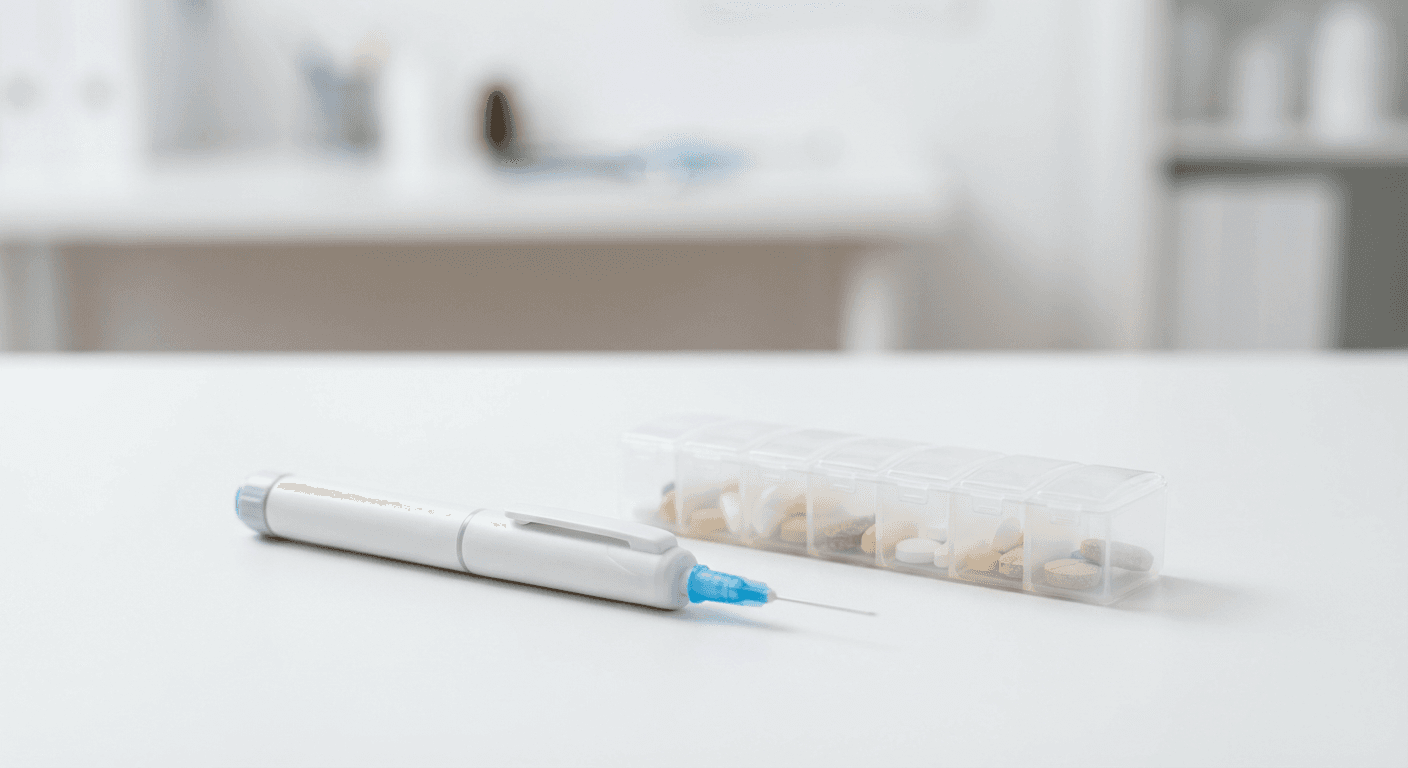
Both Mounjaro and Zepbound are delivered via the Eli Lilly KwikPen. In February 2026, the FDA approved a multi-dose version that delivers a full month of treatment from a single device. Here's what matters.
One pen = four doses. Each KwikPen contains four weekly doses of 0.6 mL each. You inject once per week, then discard the pen after the fourth dose. This is different from Wegovy pens, where each pen is a single injection.
Storage matters. Unused pens go in the refrigerator (36-46°F / 2-8°C). Once you start using a pen, it can stay at room temperature for up to 21 days, but keep it below 86°F (30°C). Don't freeze it. Don't leave it in your car in summer.
Needle attachment. You attach a new pen needle before each injection and remove it after. Leaving a needle on between uses can cause air bubbles, contamination, or medication leakage. Use a fresh needle every time.
Priming on first use. The first time you use a new KwikPen, you need to prime it — turn the dose knob until you hear two clicks, then press it to dispense a small amount. This removes air from the needle and confirms the pen is working. You only prime once per new pen, not before every injection.
Injection sites. Abdomen (at least 2 inches from the navel), thigh, or upper arm. Rotate the site each week. Press and hold the injection button for a full 10 seconds, even after you feel the click.
Missed Dose Protocol
Life happens. Here's the official guidance from Eli Lilly on what to do.
If it's been less than 4 days (96 hours) since your missed dose: Take it as soon as you remember, then resume your normal weekly schedule.
If it's been more than 4 days: Skip the missed dose entirely and take your next dose on the regularly scheduled day.
The hard rule: Never take two doses within 3 days (72 hours) of each other. Doubling up doesn't make up for a missed dose — it just increases your risk of severe GI side effects.
If you're consistently missing doses, that's something to bring up with your provider. Gaps in treatment can slow your progress and make side effects worse when you restart, because your body partially loses the tolerance it built during titration.
Common Dosing Mistakes to Avoid
Rushing the titration. Asking your provider to skip the transitional doses (7.5 mg, 12.5 mg) or shorten the four-week windows might seem like a way to get to the good stuff faster. It almost always backfires with severe nausea and vomiting that could have been avoided.
Stopping and restarting at your previous dose. If you take a break from tirzepatide for more than a couple of weeks, you shouldn't restart at the dose you left off at. Your GI tolerance resets. Most providers will have you step back at least one or two dose levels and re-titrate.
Assuming 15 mg is the goal. Some people get excellent results at 5 mg or 10 mg. The maximum dose produces the most weight loss on average, but it also has the highest rate of side effects. More isn't always better for your particular body.
Ignoring the injection technique. A subcutaneous injection that accidentally goes intramuscular (too deep) or intradermal (too shallow) will absorb differently. This can affect both efficacy and side effects. If you're unsure about your technique, the injection guide walks through the basics that apply to any SubQ medication.
Not adjusting your diet alongside dosing. Tirzepatide dramatically reduces appetite, but it doesn't change the nutritional value of what you eat. As you titrate up and eat less, making sure those smaller meals are nutrient-dense becomes increasingly important. The foods guide covers which foods tend to cause problems on GLP-1 medications and what to eat instead.
What If a Dose Isn't Working?
If you've been at a dose for at least four weeks and aren't seeing changes in appetite or weight, that doesn't necessarily mean the drug isn't working. A few things to consider before asking to escalate.
Are you actually at steady state? Tirzepatide takes about 4-5 weeks to reach steady-state blood levels at any given dose. If you just started a new dose, give it the full four weeks.
Is your diet undermining the effect? GLP-1 medications reduce hunger, but they don't prevent overeating entirely — especially with calorie-dense liquids (smoothies, alcohol, calorie-heavy coffee drinks) that bypass the slower stomach emptying. The alcohol guide covers this in more detail.
Have you used the tracking tools? The weight loss calculator can help you set realistic expectations for your starting weight and dose level, and the cost calculator can help you plan ahead financially if a higher dose means a more expensive pen.
If none of that explains it, talk to your provider. Some patients are less responsive to GLP-1 drugs and may benefit from a higher dose, an adjunct medication, or a different approach entirely. Providers experienced with these medications will have seen this before — if you need help finding one, the provider quiz matches you with clinicians who prescribe tirzepatide regularly.
Insurance, Cost, and Practical Access
Cost is a real consideration in dosing decisions. Higher doses cost more — not because the milligram price changes, but because higher-dose pens carry a higher price tag at many pharmacies.
At list price, both Mounjaro and Zepbound run roughly $1,000-$1,100 per month. Insurance coverage varies significantly. For type 2 diabetes, Mounjaro is widely covered. For weight management, Zepbound coverage depends on your specific plan — and as of April 2026, Medicare now covers Zepbound, which has expanded access for patients 65 and older.
If cost is a barrier, the insurance coverage guide breaks down which plans cover what, and the cost calculator estimates your out-of-pocket based on your insurance type. For patients paying out of pocket, exploring compounded tirzepatide through a legitimate clinic is another avenue worth discussing with your provider — though availability and legality of compounded versions have shifted frequently. The peptide therapy cost guide covers this topic in more detail.
Frequently Asked Questions About Tirzepatide Dosing
What is the standard tirzepatide titration schedule?
The standard schedule starts at 2.5 mg once weekly for four weeks, then increases by 2.5 mg every four weeks: 2.5 → 5 → 7.5 → 10 → 12.5 → 15 mg. The maintenance doses are 5 mg, 10 mg, or 15 mg. The total time from first injection to maximum dose is approximately 20 weeks. Your provider may extend the time at any step if you're experiencing significant side effects.
Is the Mounjaro dosing chart the same as Zepbound?
Yes. Mounjaro and Zepbound contain identical tirzepatide at the same dose strengths (2.5, 5, 7.5, 10, 12.5, and 15 mg). The only difference is the FDA indication — Mounjaro is approved for type 2 diabetes and Zepbound for chronic weight management. The titration schedule and pen device are the same.
What should I do if I miss a tirzepatide dose?
If fewer than 4 days (96 hours) have passed since the missed dose, take it as soon as possible and resume your regular schedule. If more than 4 days have passed, skip it and take your next dose on the normal day. Never take two doses within 3 days of each other.
How does tirzepatide dosing compare to semaglutide dosing?
Tirzepatide starts at 2.5 mg and increases in 2.5 mg increments to a maximum of 15 mg. Semaglutide (Wegovy) starts at 0.25 mg and follows a different escalation pattern to a maximum of 2.4 mg (or 7.2 mg with the new Wegovy HD). Both titrate over roughly similar timeframes. The milligram numbers aren't directly comparable because the drugs have different potencies. See the full semaglutide dosing chart for a complete comparison.
Can my provider keep me at 5 mg or 10 mg instead of going to 15 mg?
Absolutely. The titration goes up to 15 mg, but that doesn't mean you need to get there. Many patients achieve meaningful weight loss at 5 mg or 10 mg. If you're losing weight, feeling good, and tolerating the dose well, your provider may suggest staying put. The clinical trials showed 15% mean weight loss at 5 mg and 19.5% at 10 mg — both are substantial.
How long does it take for tirzepatide to start working?
Most people notice appetite changes within the first two weeks, though the starting 2.5 mg dose isn't designed for major effects. Significant appetite suppression and early weight loss typically begin at the 5 mg dose (around week 5). Meaningful weight loss — the kind that shows on the scale and in how your clothes fit — usually becomes apparent by weeks 8-12. For a broader timeline of what to expect, the GLP-1 overview covers the general pattern.
Do I need to check for drug interactions with tirzepatide?
Tirzepatide slows gastric emptying, which can affect how other oral medications are absorbed. This is particularly relevant for drugs with narrow therapeutic windows — like certain blood thinners or thyroid medications. The drug interaction checker can flag potential concerns, but always discuss your full medication list with the provider prescribing tirzepatide. If you're looking for a provider experienced with these medications, the provider matching quiz can help.
Contributing to evidence-based peptide education and provider transparency.
Too many clinics, not enough clarity?
We don't sell peptides. Tell us your goals and we'll connect you with a vetted provider who can figure out what actually makes sense for you.
See what's right for youRelated articles
A Step-by-Step Gelatin Recipe for Weight Loss
Seen the viral "pink trick"? We break down the simple gelatin recipe for weight loss. Learn our step-by-step method to help manage hunger and feel full.
GLP-1 Weight LossOzempic Cost in 2026: What You'll Actually Pay
The 2026 Ozempic cost can be anywhere from $25 to over $1,400 a month. Discover why and learn how to find savings with or without insurance coverage.
GLP-1 Weight LossHow Zep Weight Loss Works and What to Expect
Thinking about zep weight loss? We cover how this drug works, what realistic results look like, common side effects, and how it compares to Ozempic.